
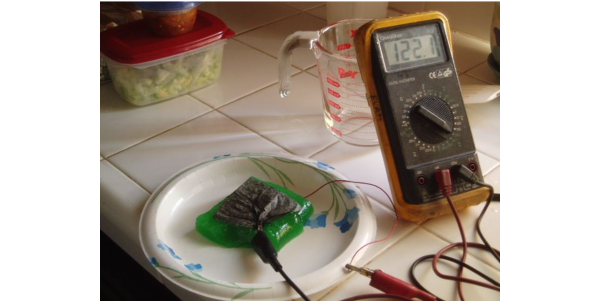
Seeking a new use for Jello? What has been tried by amateur chemists in kitchens in the past (see image above) has recently been given a new look by researchers at Queen Mary University in London, UK. They have invented an electricity-generating device made from gelatin, table salt, and activated carbon. Add a little body moisture, or water vapour, and the gel pack can continuously generate electricity. It works in the presence of moisture, which seems odd because usually the two don’t mix. But in this case, they do.
How Does It Work?
Called a MEG (Moisture-Electric Generator), it is an electrochemical storage device that serves as a low-power source. Made from a mix of gelatin, table salt and activated carbon, when dried it forms a three-layered gel pack. When exposed to an external moisture source, the MEG causes charged ions within it to begin to move, forming a continuous 1-volt current. Each MEG is like the Eveready Bunny. It keeps pumping out power for more than a month. When daisy-chained together, MEGs can produce enough power for many different electronic devices.
Ming Dong is a post-doctoral research associate in the School of Engineering and Materials Science at Queen Mary. He is first author of a paper recently published in Nano Energy describing the invention. You can find the paper here.
In a press release issued on May 21, 2026, Dong stated:
“Generating high voltages typically requires complex manufacturing processes or scarce materials. This work shows that it is possible to achieve strong performance using simple, sustainable components. By combining gelatin and salt, we have created a generator that operates using ambient humidity as its sole energy source.”
Where It Can Be Used
The implications for small electronic devices that sip energy could be staggering. MEGs could revolutionize wearable medical and wellness devices that communicate through Bluetooth and WiFi. It can provide power to a wide range of electronic devices, such as:
- Continuous glucose monitors and smart insulin patches.
- Heart rate and electrocardiogram monitors.
- Pulse oximeters.
- Blood pressure monitors.
- Rehabilitation motion-sensing bands that contain accelerometers.
- A wide range of wellness smart wearables such as head, chest bands, T-shirts, rings, belts, socks and shoes.
- Smartphone-connected remote patient monitors.
- Other non-passive devices that alarm.
- Devices with actuators to assist with mobility.
- Sleep apnea monitors.
- Speech therapy detectors that measure exhaled moisture while being powered in the process.
- Cancer drug delivery devices.
For all these types of wearables, the past challenge has been finding a power source that is lightweight and that doesn’t require frequent recharging.
When MEGs are chained together based on the work at Queen Mary, they have demonstrated the ability to produce 90 volts of power and operate for 30 days or more.
MEGs Are A Sustainable Alternative To Traditional Batteries
When I walk around my neighbourhood, I cannot believe how many discarded batteries are lying about. You find them at curbsides, in the middle of streets, and half-buried in lawns and flower beds. Why this is puzzles me and points to the downside of so many of the non-rechargeable electronic devices in use today. Throwaway power sources like these are a waste problem.
My neighbourhood drugstore has a bin inside the front entrance where people can deposit throwaway batteries. Several times a year, I have contributed a small bag of 10-volt, A, AA, and AAA batteries. Hopefully, the batteries get recycled or disposed of safely and sustainably.
MEGs, however, end the need to recycle old batteries. These gel packs are environmentally benign. They biodegrade in soil or dissolve in water. The gelatin, salt and activated carbon dissolve. All the materials are recoverable.
Dimitrios Papageorgiou, a contributing author to the Nano Energy paper, stated in the press release from the University:
“Our goal was to rethink how electronic materials are designed and manufactured.”
Besides being environmentally friendly, Papageorgiou notes:
“The ability of a gelatin-based system to generate meaningful electrical output highlights the potential scalability of this approach.”