
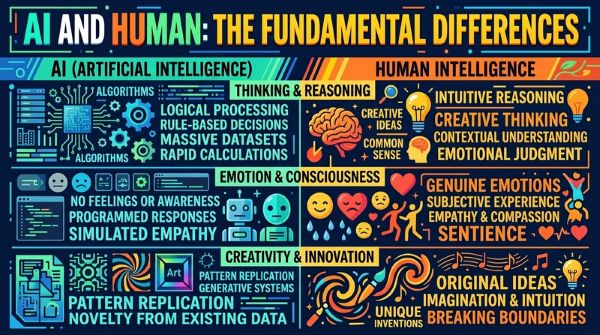
In the new world where artificial intelligence (AI) is accelerating access to information, distinguishing among the many answers the technology can deliver is a new skill we all need.
How do we distinguish ourselves from the machines we create? The answers include cultivating reasoning, wisdom and discernment.
Perfecting Reasoning
Ask an AI if it can reason, and the answer Google’s Gemini gives you states that “AI does not possess human consciousness.”
How Gemini creates a facsimile of reasoning involves a series of structured processes that emulate human thinking, supported by underlying complex computer code and logical steps. The result looks like reasoning as we know it, but it is not human.
Reasoning doesn’t drive most human decisions. Habits, emotion, heuristics (mental shortcuts involving no mental effort), context and more determine the decisions we make. Humans often talk about commonsense. Commonsense, however, is biased by habit and often ignorant of many facts and evidence.
To perfect reasoning requires learning a decision-making process that is repeatable and reliable. That’s what underlies the scientific method. This structured reasoning process begins with observation, hypothesis and prediction. The goal is to find whether your reasoning leads to a predicted outcome. That’s where experimentation comes in to test the validity of the hypothesis and see if your prediction is accurate. Based on the test outcomes, you can revise or replace your hypothesis and test again. The scientific method requires that reasoning be validated by repeatability.
Many hypotheses fail the repeatability test. Think, for example, of the cold fusion hypothesis that emerged from a 1989 experiment at the University of Utah and captivated some scientists and engineers to try and repeat the results.
Training to perfect reasoning involves asking questions. From questions come ideas. From ideas come potential solutions. The ones you want to be true need to be tested. Wishful thinking is wanting something to be true even though it isn’t necessarily the case. Wishful thinking isn’t reasoning.
Demonstrating Wisdom
When I was a child, my Grade 6 teacher called me a walking-talking encyclopedia. I was unusually well-read and a brat about sharing what my plastic youthful brain had absorbed. Was I wise? Hardly.
Wisdom doesn’t come from facts alone. Wisdom requires seeking different perspectives, asking questions, observing role models, and study. Ask Gemini if it is wise, and this is what it says:
“If we define intelligence as the ability to process information, solve logical puzzles, and find patterns, then Gemini is highly intelligent. But wisdom is a different story.”
Human wisdom isn’t based on statistical patterns but rather on lived experiences, reflection, empathy and moral accountability.
AI intelligence is about finding statistical patterns in vast amounts of training data and algorithms programmed to find the right answers.
Human wisdom knows that sometimes there is no one right answer, but possibly many. Human wisdom achieves answers through understanding, judgment, knowledge, intelligence and a moral compass. Wisdom is often learned from making mistakes and not repeating them. In some sense, it is the scientific method applied to thoughtful daily living.
Applying Discernment
Ask Gemini if it practices discernment, and the answer it gives is “No.”
At best, an AI can create “the appearance of discernment.” That’s why, when asked a question, an AI can end up going down a rabbit hole to produce conclusions that seem reasoned but represent poor and often dangerous results. That’s why befriending an AI and asking it for advice can lead to a tragedy like the interactions between ChatGPT and an 18-year-old that led to the killing of eight people in Tumbler Ridge, British Columbia, on February 10, 2026.
Human discernment involves consequential thinking, weighing the strengths and weaknesses of potential decisions, and a pregnant pause before articulating a response. AIs don’t do this.
Discernment doesn’t arrive from wisdom alone or accumulated facts read in books. It comes out of human interactions and life experiences that include mistakes and teachable moments. It involves curiosity, empathy, humility and the ability to recognize cognitive biases picked up from the social groups and individuals with whom you interact. Discernment involves admitting being wrong and revising ensuing behaviours.
Although an AI like ChatGPT claims that it can exhibit faulty reasoning when responding to questions, it cannot discern its error from an emotional state, but rather from its training and human-engineered code. In other words, faulty “information in” leads to faulty “information out.” No blaming the AI for its implied lack of moral compass.