
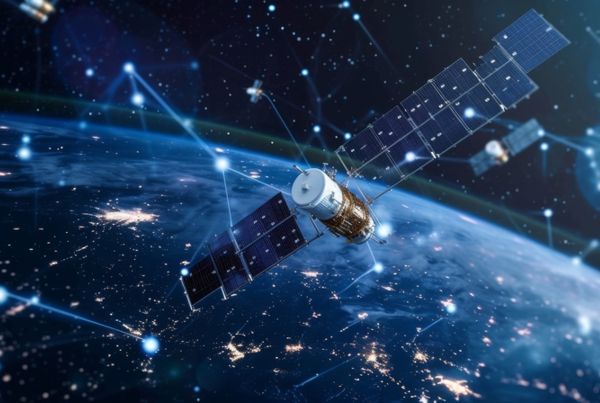
The current number of active satellites circling Earth is about 11,000. That is a little more than one quarter of the discrete pieces of machinery we earthlings have launched into space. Those totals don’t include loose debris from human activities in space, like lost screws and such.
What is clearly evident is that our bad habits cultivated here on Earth are now invading near-Earth space. A recent European Space Agency (ESA) 2025 report estimates more than 1.2 million space debris objects larger than 1 centimetre (0.39 inches) are circling Earth, with 50,000 of these larger than 10 centimetres (3.9 inches). The ESA report notes that within an altitude of 550 kilometres (341 miles), the amount of debris exceeds the number of operating satellites.
Defunct satellites that are hit by orbiting space junk travelling at 29,000 kilometres (17,500 miles) per hour cause fragmentation events. In 2024, several of these collisions added 3,000+ pieces of orbital debris.
SpaceX, Starlink, Space Debris Management
The current Starlink network has 9,347 operational satellites and only 3 that are no longer functioning but still in orbit. SpaceX, the builder of Starlink, has launched many more than the current plus 9,000 number. The strategy involves quick deorbits to ensure limited accumulations of defunct spacecraft and therefore less opportunity for collisions.
Starlink satellites can maneuver. The latest generation incorporates autonomous navigation technology. SpaceX reports thousands of maneuvers annually to prevent collisions. Recently, the company lowered the orbits of approximately 4,400 satellites in the network to reduce the threat from space weather destabilizing orbits, and making it much easier to deorbit to be replaced by satellite upgrades.
Competition For Starlink Adds To The Debris Challenge
The ESA report identifies collisions in low-Earth orbit (LEO) as a major future challenge. Currently, the number of collisions remains small. Consider this, however, the Starlink network will continue to grow and will be joined by a growing number of competitors. Here is the current and near-future list:
- AST’s SpaceMobile,
- Eutelsat’s OneWeb,
- Blue Origin’s TeraWave and Kuiper (now called LEO),
- China has two, Qianfan and Guowang,
- ESA’s IRIS,
- and Russia’s Rassvet.
The innovation that these space-based networks hope to bring in connecting everyone on Earth could also spell the death knell of LEO as a resource. Every additional launch brings the potential for a future space catastrophe.
Unsustainable Practices Threaten Near-Earth Space
What can space debris teach us about the failings of our so-called progress in the 21st century? Technology that makes it easier for us to connect, when designed and deployed like these satellite constellations, demonstrates unsustainable practices. We continue to launch stuff on one-way trips.
Whether we are talking about the SLS mega rocket of the Artemis Program, or satellite constellations, we use linear thinking, building and sending what is manufactured here on Earth with valuable extracted and finite materials on one-way trips to space. The SLS is a multi-billion-dollar throwaway. The satellite constellations, once deployed, have best-before dates. We don’t plan to refurbish and reuse. We don’t plan to recycle. Instead, we destroy.
Our technology mindset continues to be linear. Almost everything produced in our 21st-century world, whether for use here on Earth or in space, reflects a throwaway mentality. In space, the result is space junk or deorbiting burnups with unknown atmospheric environmental impacts. On Earth, what we produce usually ends up in landfills, garbage dumps, or incinerators.
Reusability Critical to Near-Earth Space Sustainability
“Shared space without shared rules creates shared problems,” states an article in a recent issue of The Bulletin of the Atomic Scientists. Turning LEO into a giant landfill represents a tragedy of the commons. Commercial exploitation of LEO with the current Starlink constellation and those planned by others is expanding rapidly. Thousands of satellites are being launched annually. Congestion will lead to collisions.
I have written about the Kessler Syndrome. It appears we are on a path to this catastrophic outcome because we don’t want to shift from our linear extractive manufacturing processes, or we don’t know how to make circular economy processes work for us in space.
SpaceX has demonstrated with the Falcon 9 rocket that launch vehicles can be partially reused. Blue Origin’s New Glenn has similar technical capability. Stuff we put into orbit should be similarly designed for deployment, recovery and reuse. If we don’t achieve this in LEO, we are only a few years from a catastrophic chain of events that will make this part of near-Earth space unavailable to us for decades and longer.
The Bulletin article writes:
“Losing access to Earth’s orbit would undermine climate science, disaster response, agriculture, transportation, and the global coordination of communication and navigation networks.”
In ESA’s report, it states:
“The net growth of the space debris population and the Kessler syndrome risk make clear what must be done if we want to continue using our space environment. There is a growing consensus…that stricter space debris mitigation practices need to be implemented globally to keep space activities viable.”