
I recently bought my leased, five-year-old Toyota Venza. With low mileage and a better book value than the lease buyout, it made sense. We had long ago rid ourselves of our second car in an effort to reduce our carbon footprint. The Venza, being a hybrid, reduced the footprint even more and represented an interim solution before going fully electric.
I drove the Venza for over five years with all-season radial tires. There was lots of wear left, but concerns for winter safety made me consider going to winter or all-weather tires.
In most of Canada, winter tires are commonly used from November to April. Winter tires mean owning an extra set of tires and often rims and finding a place to store them during the twice-a-year switch. Winter tires grip road surfaces better when temperatures drop to freezing and below. The rubber used in winter tires is softer, leading to faster wear.
After a discussion with my Toyota dealer’s service department and knowing where I drive in the winter, they suggested I could avoid the all-season and winter tire switch routine and buy all-weather tires, a classification to which I was unfamiliar.
All-weather tires wear faster than all-season, but less than winter tires. They provide good traction in snow and slushy conditions. Where we live, we seldom see heavy snowfalls, and if and when they happen, I don’t venture out. So my Venza now has four brand-new wheels.
Should I be happy? Not so fast when you read about tire pollution.
Tire Wear is a Biohazard
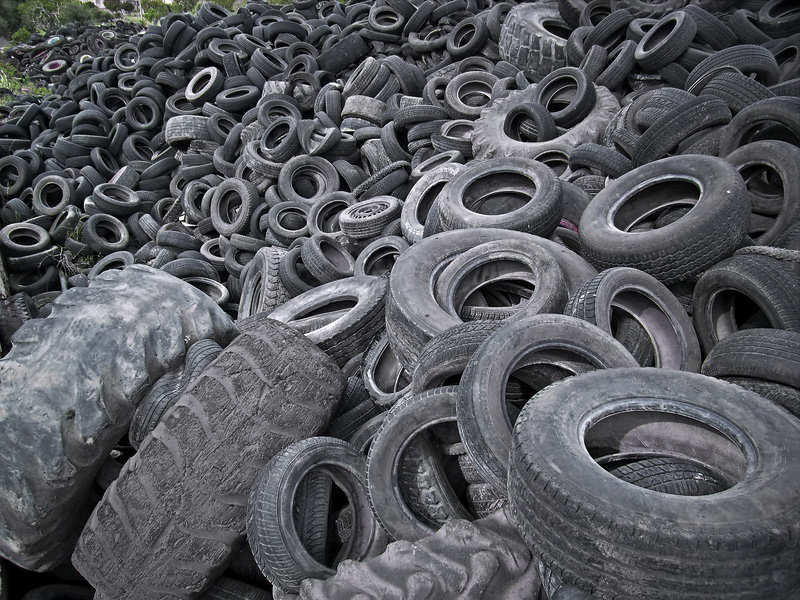
When we think of tire pollution, we usually consider the waste problem from discarded tires. Every year, 1.5 billion tires, representing over 20 million tons, enter the waste stream. Most end up in landfills. About 40% are partially reused and recycled, with 15% burned for fuel in kilns and furnaces.
Pyrolysis is used to recycle tires, with heat applied to break down the rubber into fossil fuels and char. Magnets remove wire and steel belts from tires for recycling. Pyrolysis as a process produces GHGs as well as polluting compounds like polycyclic aromatic hydrocarbons, dioxins and furans.
But in the tire lifecycle, there is an almost unseen pollutant that seldom gets discussed. It is microparticles from tire wear. This microscopic tire pollution is a hidden danger to the environment and human health.
Research at London’s Queen Mary University is being led by James Busfield, Deputy Head of the School of Engineering and Materials Science and head of the Soft Matter Group. Professor Busfield worked in the automotive sector before teaching. His research focuses on pneumatic tires and how the material in them wears and sheds microscopic particles upon contacting and deforming on road surfaces.
Tire wear debris constitutes between 25 and 40% of the microplastic pollution found today in oceans, waterways and marine ecosystems. The particles persist in the air, water, soil and living organisms. They find their way into the deepest recesses of lungs, contributing to impaired lung growth in children and cardio-respiratory diseases in adults.
In a press release from Queen Mary University issued today as policymakers, industry and world leaders meet at COP31 in Antalya, Turkiye, Professor Busfield described the nature of the environmental threat in the face of our reliance on tire-based transportation:
“As we move towards a more sustainable transport system, we need to consider the entire environmental impact of mobility. That means understanding not only vehicle emissions, but also the materials we use, how they wear and what happens to them at the end of their life.”
Unless you’re using rail, ships or airplanes, tires are a fundamental part of global transportation. Road tires are designed to deform as they grip surfaces. They are filled with air to help them adjust to the bumps and potholes encountered during transportation. It is the give and nature of the materials used in tire manufacturing that creates the microparticle shedding from road contact.
That’s why Busfield’s research team is working with manufacturers to assess the environmental damage caused by tire microparticles, and to experiment with new materials and manufacturing processes to try and produce a tire that sheds less.
Alternatives to Rubber Tires
The invention of the wheel created a transportation revolution. Before it, our feet, sleds in winter, A-shaped frames called travois in summer, and watercraft, getting from point A to B required stamina. Wheels and cross axles changed all of that. Pneumatic tires were first invented in 1845 but were popularized with the introduction of the inflatable rubber tire for bicycles and tricycles in 1887.
Rigid Engineered Tires
Non-pneumatic tires represent an alternative to the kind of tires we use today. These are airless, replacing the air chamber with an engineered structure.
If you are looking for examples, go to Mars. The two active NASA rovers, Curiosity and Perseverance, use rigid, flight-grade aluminum and titanium in each of their six wheels. They are designed to deform when riding over rough terrain. On Mars, a pneumatic tire wouldn’t survive the extreme temperature swings, abrasive dust and a terrain that no one could describe as being roadworthy. Driving at much slower speeds than wheeled transportation here on Earth, the two rovers are demonstrating one kind of alternative.
As for suitability here on Earth, not likely unless deployed on a toddler’s red wagon, albeit a very expensive one.
Continuous Tracks
Tracked vehicles include tanks, tractors, mining and on-site construction equipment like bulldozers, excavators, shovels and backhoes. Tracking systems maintain contact with off-road surfaces better than pneumatic tires. The best example of highly mobile tracking systems can be found in snowmobiles, where the rear rubber tracks provide traction on snow and ice while upfront mounted skis are used to steer.
On roads, steel-tread tracking systems like tanks and military transports damage pavement. Rubber-surfaced tracks do less damage, but when in contact with road surfaces, they produce the same kind of microparticle pollution as tires.
Compared to pneumatic tires, tracks for mass transportation needs such as the trucking industry would be slower, less energy-efficient, produce faster wear, and require more maintenance. A thrown track is harder to replace than a flat tire.
Tires in a Net-Zero, Sustainable Future
We can electrify transportation to achieve net-zero emissions. That will not, however, address the biohazard that modern tires represent. Short of levitation, tires represent our best means of achieving a wide range of transportation choices for personal and business transportation.
Let’s hope that Professor Busfield and the work by others researching safer wheel materials and road surfaces, therefore, tackle the microparticle pollution that is a consequence of our 21st-century highly mobile world.