
In Part 1 of A Climate Change Wakeup Call, a global and Canadian report described the fix we are in. Climate change is a problem of our own making. The finger-pointing requires more than the ten we have at hand.
Who has known about how we humans were changing the planet’s climate?
Scientists knew about the greenhouse gas (GHG) effect since the 19th century at the dawn of the Industrial Revolution.
Industrialists could witness the evidence for themselves every day as their foundries and factories spewed GHGs.
Utilities knew when they chose to burn fossil fuels to generate electricity, even with the knowledge of cleaner alternatives.
Of course, the fossil fuel industry knew, with their laboratory results showing the link between their industry and climate change since the 1950s.
Governments knew. Doctors and the healthcare community knew. Consumers even had an inkling.
All that knowing, and no one was doing anything to stop it.
Knowing Isn’t Doing
The annual climate change rite of passage is called COP. COP stands for Conference of the Parties. This annual United Nations summit began in 1992 and has been going strong ever since. Nations around the world gather to talk about climate change, propose solutions, sign agreements, and then… nothing.
You may disagree with the last part, but look at a measure of the results to date. CO₂ concentrations in the atmosphere in 1992 were 356.5 parts per million. With 2026 not yet at an end, the latest July data show CO₂ concentrations at ~429 ppm. If you plot the trend based on observations from 1960 to the present, the graph looks like this: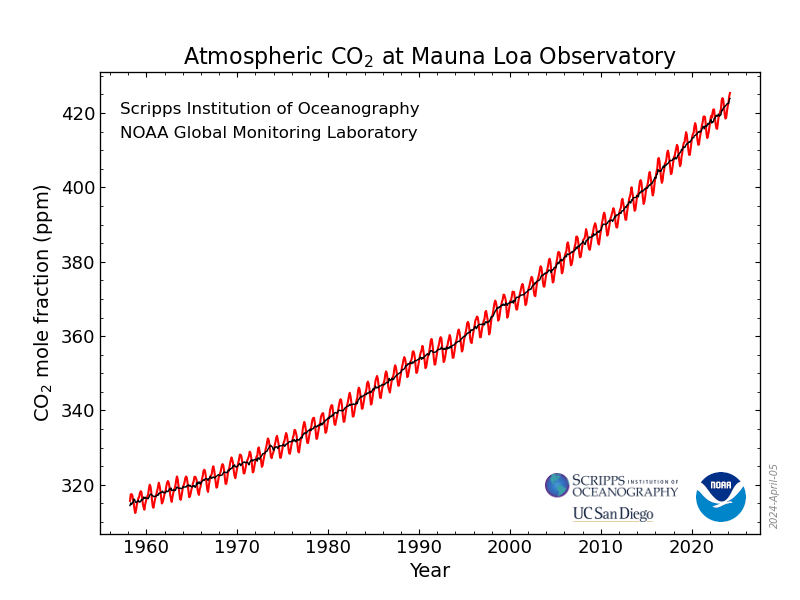
Does the upward-bending curve demonstrate that we collectively don’t know what we are doing about CO₂, the prime GHG associated with global atmospheric and ocean warming?
Global Behaviour Modification – Is it Working?
In 2015, a COP meeting produced the Paris Climate Agreement, with 195 countries agreeing to voluntarily tackle climate change by targeting GHG emissions. Since then, the number has dropped twice when the United States withdrew during both presidential terms of Donald Trump.
The Paris Agreement committed humanity to global behaviour modification. We were to limit global warming to 2°C (3.6°F) and ideally make best efforts to limit it to no more than a 1.5°C (2.7°F) rise above pre-Industrial Revolution atmospheric temperatures. To do this, countries were going to faithfully measure carbon outputs, called national stocktaking. They agreed to regularly report on progress to reduce carbon outputs.
Subsequent annual COP meetings have shown that using collective behaviour modification doesn’t work. The results indicate mitigation efforts have done little to slow down rising CO₂ levels and temperature rise.
Even the commitment by Global North and other rich countries to create an adaptation and mitigation fund to help Global South countries combat climate change has fallen well short of its financial target of US$ 100 billion annually beginning in 2020.
Why hasn’t behaviour modification worked? A sampling of national commitments and actions that appear to have failed or stalled includes:
- Canada, where a progressive consumer carbon levy was introduced and eventually abandoned.
- China, where the country committed itself to an aggressive buildout of renewable energy projects while still building and operating CO₂-producing coal-fired power plants.
- The European Union, which set ambitious and yet-to-be-realized emission targets and standards.
- The United States, where Democrats in the White House passed progressive legislation to incentivize decarbonization, only to be stymied when Republican leaders declared climate change a hoax.
Pulling Back from Climate Tipping Points
Climatologists express concern that the upward-bending curve seen above will eventually lead to long-term climate disaster.
With behaviour modification’s failure as a collective strategy, we now appear to be falling back on technology rather than the natural options of ocean, forest, seagrass, peat bog, soil, and permafrost carbon sinks. Apparently, they can no longer cut the mustard.
Why? Natural carbon sinks appear to be nearing their maximum capacity to sequester CO₂. Oceans can only suck up so much before becoming warmer and more acidic. Planting more forests doesn’t appear to be offsetting forest loss from human exploitation and wildfires. Droughts are making peat bogs and soil untenable. Meanwhile, the Arctic is witnessing unprecedented permafrost melt, turning it into a net carbon emitter.
Technological wizardry is now our answer to failing to keep CO₂ in the bottle. Often talked about, carbon capture and sequestration (CCS) has become the rage. We have technologies that can suck CO₂ from chimney stacks and from ambient air. The problem is getting CO₂ polluters to pay to implement these technologies.
We are talking about fossil fuel and utility companies who for years have pumped out oil and natural gas, or burned these fuels and coal to generate electricity. They have put profits before social and environmental good.
Governments, meanwhile, have wanted the fossil fuel companies to pay for CCS and direct-air carbon (DAC) capture. The companies, which have benefited from fueling and feeding oil demand, making tens of billions of dollars, want the public to pay the lion’s share. Meanwhile, the fossil fuel industry and utilities show little remorse for dumping climate-change-causing pollutants into the commons: the air we all collectively breathe.
One such project represents a good example of the challenges we face. It is Canada’s Pathways Alliance. First announced in 2021, it involves a consortium of six fossil fuel producers constructing over 2,000 kilometres (1,240 miles) of pipeline to transport CO₂ from oil sands production sites to a location where the gas would be pumped underground.
Five years later, it is 2026. The Pathways project has yet to lay a kilometre of pipe. The companies aren’t even sure it will work. Who pays remains unresolved.
That we have reached this point, requiring tens of billions of dollars to begin to remove climate-changing pollutants, seems inexplicable. Yet, that is one of the nuclear options being touted to resolve the growing climate change crisis.
Of Course We Could Always Do With Less Oil and Gas
If we know excess CO₂ is the prime driver of climate change, we should be able to produce less of it. But our thirst for energy in the 21st century keeps throwing a monkey wrench into the works whenever we talk about learning to do with less.
Less would mean a rapid transition to 100% electrification. The electricity would come from renewable, nuclear and other low-to-net-zero sources.
Less would mean no more diesel- and gasoline-fuelled transportation, no more ships burning bunker fuel, and air transportation would replace jet fuel with hydrogen and batteries.
Needless to say, we aren’t even close to achieving any of the above at present.