
Two reports on climate change have “we told you so” implications. They should be a climate change wake-up call for all humanity. Unfortunately, the noise of current geopolitical events has put the environment on the back burner until this last week, when a Himalayan glacier in Tibet began to collapse, causing a devastating flash flood that has killed thousands and left many more missing. What was the cause of this devastating event?
CLIMATE CHANGE!!
At the same time, two reports added to the climate change cannon fodder. The first was the World Meteorological Organization (WMO) global update on climate. The second is the Canadian Comprehensive Climate Report (CCCR2026) published yesterday. The first stated: a 91% likelihood that the planet’s mean temperature will exceed 1.5°C (2.7°F) in one of the next three years. The second stated that Canada was warming twice as fast and the Canadian North three times as fast as the rest of the planet.
In this posting, Part 1 of 2, we summarize the findings of the two reports. In Part 2, we point fingers and restate the long-put-off actions needed to remedy our planet.
WMO Report on Climate Change
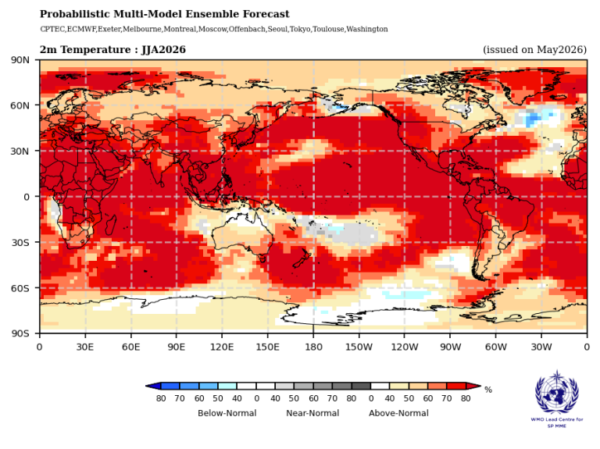
The map seen at the beginning of this article appears to be largely covered by red.
It points to the planet running a fever and comes from the WMO report, which estimates a 75% likelihood that between 2026 and 2030 the atmospheric mean temperature will exceed 1.5°C (2.7°F) above the period that began with the Industrial Revolution in the mid-19th century.
Over these next five years, the WMO forecasts a mean global atmospheric temperature of between 1.3°C (2.3°F) and 1.9°C (3.4°F), with the poles outpacing these levels of rise.
I have provided a link to both a summary and the full report if you wish to dig into the details.
Canada’s Report on Climate Change
Speaking of details and closer to home, Canada’s second comprehensive report on climate change, CCCR2026, showed up on September 3, 2026, with no fanfare, no panel of scientists for the press to pump, and very little media coverage. Downplaying the report probably has a lot to do with the current U.S.-launched trade war against Canada, which has sucked all the air from this important report.
CCCR2026 tells a tale: a summation on the current state of climate change across Canada. In a nutshell, it points to rising atmospheric temperatures as a consequence of increasing global levels of greenhouse gas (GHG) emissions caused by human activity.
What does the report state? Here are some of its observations:
- Warming of the country over the past 75 years by 2.0°C (3.6°F), twice the global average.
- Mean temperature increases of 2.6°C (4.7°F) in the North, three times the global average.
- Expected warming forecasts through 2040 show temperatures rising another 1.0°C (1.8°F), even higher in the North.
- Warming is creating consequences including:
- More frequent and more extreme weather events.
- Changes to the Northern Jet Stream associated with increasing extremes of heat and cold.
- Earlier and longer fire seasons.
- Earlier snow and ice coverage melts impacting river flow rates and lake levels.
- Thinning glaciers across Western Canada with expectations that they will almost vanish by 2100.
- Decreasing Arctic sea ice contributing even more to warming across the country.
- Increasing greening and expansion of Canada’s boreal forest coverage, providing an enlarged carbon sink.
- Increased thawing of permafrost, counteracting the boreal forest carbon sink as more CO₂ gets released.
- Warming and acidification of Canada’s coastal ocean waters.
- Rising sea levels from thermal expansion and surface and land ice melts.
- Changing fish and other marine life populations as the oceans warm.
- Annual precipitation has risen across Canada in parallel with temperature rise, leading to the following:
- Larger increases in precipitation in the North than the rest of the country.
- More frequent and longer droughts in the West.
- Increasing atmospheric river events and extreme rainfall incidents everywhere.
- More flood events associated with extreme precipitation and higher winter snowfalls leading to bigger spring snow melts.
What Both These Reports Indicate
The planet is in trouble. Humanity is in trouble. Future generations are in trouble. The consequences of ignoring the root causes of climate change are coming home to roost.
In Part 2, the finger-pointing will be very direct, as will the discussion about the players and actions needed to benefit the planet, and here, in our corner of it, Canada.