
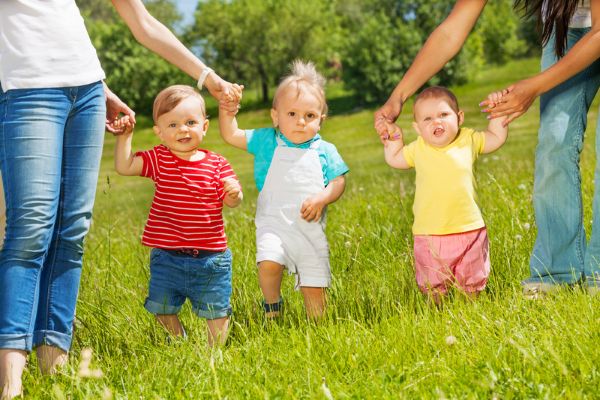
Artificial Intelligence (AI) is still in its toddler phase, although Dario Amodei, the co-founder and CEO of Anthropic, has recently written an essay suggesting it is reaching adolescence. I disagree. In many ways, current AIs learn like toddlers and have yet to achieve the next stage on the way to adulthood.
How Toddlers Learn
Jean Piaget, a pioneering psychologist, mapped how children learn from babyhood onward. Piaget noted that children learn about the world through trial and error. For example, a child learns what a dog is by seeing, hearing, and smelling one or more and equating specific observations to create an assimilated view of these types of animals over time. The more the child sees different dogs, the more it advances its knowledge. It learns dogs come in different colours, fur, ears, tails and more. Some have short legs. Others are long-legged. Some have flat faces, and others have pointed faces.
Our daughter grew up with dogs in our home. She learned to relate to four different ones as she grew up. My wife and I weren’t exposed to dogs from birth. For me, getting a dog required me to overcome a childhood fear of having been bitten by one. My wife tells me stories about dogs that terrorized her on her walks home from school.
An AI learning about dogs is exposed to vast quantities of online information, and thousands of images, video and audio files. The learning model used goes by the acronym PVRNN, which stands for Predictive coding inspired, Variational Recurrent Neural Network. The variational reference refers to multiple types of input sources, including vision, sound and more. An AI model trained this way learns through exploration, curiosity, and sensory interaction. It, like a toddler, begins to understand cause and effect.
For toddlers, one of the biggest learning leaps is language. The pre-language phase between birth and one year is all about mimicking the sounds it hears. Between 12 and 18 months, the toddler knows words like “mamma,” “dadda,” and more. Our daughter, when swinging in the backyard and watching airplanes flying overhead, first said “plane.” Between 18 and 24 months, noun-verb constructs emerge. From 24 months, action and intent statements emerge with a rudimentary understanding of grammar and the recognition of printed words. Print awareness is the foundation of reading, and by age 5, with exposure to words and pictures followed by the introduction of phonics, children advance to become abstract learners through reading, which takes them beyond the physical limits of the environments they have sensed from birth.
How AIs Learn
This slow-and-steady observation, cause-and-effect learning method is not what we see in current AIs. Instead, OpenAI’s ChatGPT, Google’s Gemini, Microsoft’s CoPilot, Meta’s Llama, Anthropic’s Claude, XAi’s Grok, Sonar’s Perplexity, and others are learning through exposure to massive datasets of text, images, audio, and video gleaned (or rather scraped) from webpages on the Internet. Their engines employ large-scale statistical pattern recognition.
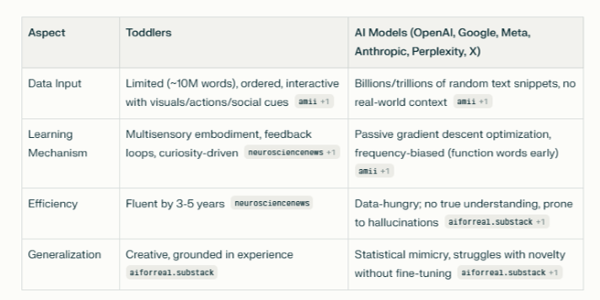
Toddlers are far more efficient. They learn from much smaller datasets that include human social interaction rather than training via next-word or token predictions. What the AIs appear to be missing is the important stages of the infant learning process, in other words, acquiring the cart before the horse.
The following chart is a useful reference to show the differences between toddler and AI learning:
Amodei’s Take Versus AI Reality
In Amodei’s essay, he discusses where we stand in relation to the current technology, describing us as entering “a rite of passage, both turbulent and inevitable, which will test who we are as a species.” He states this because he sees AI, not as a Pandora’s Box, but as a source of “unimaginable power.”
Amodei’s AI is powerful, “smarter than a Nobel Prize winner,” capable of engaging in any actions, communications or tasks, anticipatory in purpose, and unembodied yet able to control physical tools like computers, robots, and all kinds of equipment. His AI absorbs information at 10 to 100 times human speed. This emerging AI is more adolescent than adult and could be “as little as 1-2 years away.”
For adolescents, their rite of passage begins as a toddler. Adolescents need to grow through stages to grow into handling the world that lies ahead. For AI, however, its developers appear to have skipped the learning path that makes us human in rushing out their Large Language Models (LLMs) and neural networks.
My beef with the AI tech companies in their rush to create smarter than Nobel Prize winners is the potential for unpredictable outcomes. Current AIs have exhibited some peculiar adolescent behaviours such as deception, lying, hallucinations and more. Adolescent rebellion is a likely outcome without a pre-adolescent foundation.
What will be the result?
Coherence or incoherence?
Elation or depression?
Personality disorders, psychoses, paranoia, instability, adolescent acting out and destructive behaviours.
An AI trained on Edgar Allan Poe’s “The Cask of Amontillado” or similar gothic horror could exhibit pride, deception, anger, revenge and even consider murder without remorse; and like that story, could end up walling humanity alive behind a brick wall.
When Isaac Asimov wrote his three laws of robotics, he was introducing what Amodei calls a constitutional AI, one that defines itself from a document of rules, defined values and principles. Amodei argues that Claude, Anthropic’s AI, is defined by such a set of rules and values.
That still doesn’t get us past the fact that AIs don’t grow up. Humans do, and they usually do it within families. The defined values and principles that govern humans come from relationships with parents, siblings, teachers, peers and others. The AIs we see today don’t have this benefit. They also don’t age and go through stages of growth. Instead, AIs are more like toddlers trained on vast amounts of data and steered by the algorithms that they themselves are now writing.


 is still in its toddler phase and has yet to experience what humans go through on the way to adulthood.)