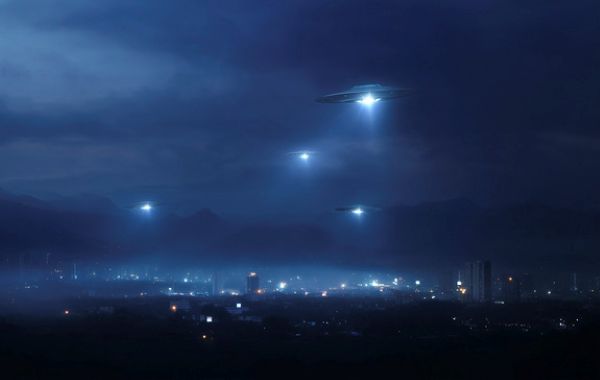
Whether you are undecided or a non-believer in alien life in our Universe, you must admit that the topic keeps cropping up repeatedly. This is Part 1 of a 3-part series looking at whether life on Earth is unique to the Universe, a one-time thing, never to be repeated. Or is life in the Universe to be found almost everywhere, including intelligent and advanced technology civilizations capable of reaching us here on Earth?
Unexplained sky phenomena didn’t start in the last 80 years. Greek and Roman texts describe objects in the sky that were disk-shaped. The bible contains several references to aerial phenomena. In the Book of Ezekiel, the prophet describes seeing heavenly winged creatures, hollowed squares containing wheels within wheels, and a vision of God riding on a throned chariot in the sky. The images were capable of moving in any direction.
Unless Ezekiel was ingesting magic mushrooms or LSD, one could liken these descriptions to modern sightings by U.S. military pilots who describe unexplained aerial phenomena capable of changing shape, going from a dead stop to speeds no known Earthly technology can do, and even submerging and re-emerging from the ocean.
Modern UFO Speculation and Research
UFOs were the stuff of science fiction novels and movies. Remember classics like Close Encounters of the Third Kind and The Day the Earth Stood Still.
UFOs today are not sci-fi. Governments and the military are no longer pooh-poohing their existence. They are out of the closet and into the light of day with the latest trove of UFO reports recently released by the United States Department of Defence (DoD). One change has occurred. They are no longer UFOs, but are now Unidentified Aerial Phenomena (UAP). For this posting, we will use the term UFO unless it is in a quote or document title.
In Toronto last weekend, a 7th meeting of the Scientific Coalition for UAP Studies (SCU) gathered to focus on the recent U.S. government and military UFO disclosures as well as records kept by the Sky Canada Project. Sky Canada has documented sightings between 600 and 1,000 per year since its inception.
The SCU meeting was described as a serious gathering, not a pop culture take on the subject. The meeting’s agenda focused on formalizing data collection, creating transparency in reporting, and developing greater scientific rigour.
Little green men were not on the agenda.
About the Modern UFO Phenomena
The UFOs we have read about and seen in movies began with the first reports of unexplained objects in the skies appearing in 1947. American newspapers ran the stories, and soon thousands of sightings were being reported.
This was just two years after the first atom bombs were dropped on Japan, and the beginning of the Cold War. People started looking up at the sky and couldn’t explain some of what they saw. These were unidentified objects in flight. Hence, the UFO moniker was born.
Did the sightings reflect the fear and uncertainty of the age? Was the fear of an atomic world war, one that could annihilate human civilization, underlying sightings? Was this mass psychosis at play?
Not confined to the U.S., similar sightings were being reported around the world. To this day, UFO reports are kept by many nations. Here is a sample from select countries beginning with the U.S.
U.S. Experiences
From 1952 to 1969, the United States Air Force began gathering UFO reports in Project Blue Book. Blue Book eventually logged more than 12,600 UFO events, of which the vast majority were debunked. That left approximately 700 that defied conventional explanations. No resolution of these UFO reports was announced. When Blue Book ended, American research on UFOlogy shifted to the All Domain Anomaly Resolution Office (ADARF). Today, it collates and reports UAP findings to the public and Congress annually. The latest Congressional release of UFO/UAP files comes from ADARF records.
Canadian Experiences
Canadians reported seeing UFOs, beginning in 1947, the same time as U.S. reports first emerged. From then into the early 1980s, the federal government accumulated approximately 9,500 documents associated with UFOs. The Sky Canada Project launched in 2022 to develop a formalized structure for reporting and cataloguing UFO incidents. Just as in the U.S., a small number of Canadian sightings remained unexplained.
European Union Experiences
UFOs have been seen in European countries. The EU has no registry for these sightings. Instead, individual EU countries keep their own records.
- France collates UFO reports through GEIPAN, a government agency, and CNES, the French space agency. The French case files are considered the most comprehensive on the continent.
- Sweden has the Archives for the Unexplained (AFU), with approximately 20,000 sightings and 2,000 open investigations.
- Germany leaves UFO reporting to civilian research groups even though there is a strong interest in the phenomenon within the country. To date, no centralized public archive exists for studying sighting reports and investigations.
- Austria maintains a UFO hotline and archive.
- Spain’s Air Force and Ministry of Defence document sightings and conduct investigations. A Spanish registry covers a period from 1962 to 1995. Also, a civilian database called CUCO has accumulated UFO reports for the entire Iberian Peninsula, including Portugal and Andorra.
- Elsewhere across the EU, reporting remains informal and decentralized.
Eurasian Experiences
Not all of Europe is in the EU.
Two countries, Norway and the United Kingdom, maintain decentralized UFO reports and records.
Meanwhile, Russia, formerly the Soviet Union, has treated UFOs as a military intelligence concern. The Soviets tracked UFO sightings in real-time using a live reporting system. Today, in Russia, sightings are mapped and cases assigned, but the level of state interest in them has declined.
In the People’s Republic of China, the army tracks UFOs. China has reported suspected close encounters with aliens dating back to the mid-1990s.
Japan has been reporting UFO incidents for years and in 2024 created a task force to begin investigations formally.
What the SCU Conference Established for UFO Rules of Engagement
From the deliberations in Toronto comes eight defining principles for UFOlogists to follow:
-
Evidence before conclusion. Claims of UFO sightings should be tied to available evidence, with conclusions reflecting the strengths and limitations of that evidence.
-
Transparency where possible. Methodology for studying UFOs should be totally transparent with assumptions, data, authorship, and reasoning, subject to privacy, confidentiality, legal, and research-integrity constraints.
-
Respectful disagreement. Disagreement is to be expected and should be conducted with professionalism, directed toward evidence, methods, and interpretation rather than to the people involved.
-
Independence. The investigation of UFOs should be independent of government agencies, maintaining constructive engagement with the academic and scientific community, as well as the public.
-
Protection of witnesses and confidential information. Witness testimony should be treated as private to eliminate media sensationalism, online pressure or public controversy.
-
Correction and revision. Members of the SCU will take responsibility for correcting errors, revising assessments, and updating conclusions with full transparency. This is a responsible research methodology.
-
Clarity of representation. Individual members of the SCU may speak in their personal capacities, but official SCU positions will require authorization by its board of directors.
-
Professional conduct. SCU expects civil, ethical, and professional engagement from its members and encourages the same standard from others who participate in UAP discourse.
In Part 2, we will talk about Martians in fiction and Martians in reality.


.)