In Part 1, we didn’t exhaust the UFO conversation, but rather put it aside to be revisited in the future. Having done that, in Part 2, we have moved on to look at Mars and its contribution to our understanding of whether we are living on the sole planet to support life here in the Solar System or elsewhere in the Universe.
Percival Lowell, Ray Bradbury and H.G. Wells Perceptions of Mars
Our ideas about life beyond Earth have changed over time. Before telescopes, Greek philosophers represented two schools of thought. Some, like Democritus, believed that the stuff that made us existed everywhere, and therefore life beyond Earth of various shapes and purposes must exist. Others, like Aristotle, saw Earth as the centre of the Universe and uniquely gifted. Life, therefore, would only be found here.
Aristotelian thinking dominated Medieval Western speculations until the telescope began to reveal the nature of our Solar System neighbours.
Venus’ hidden surface, a planet enveloped by thick clouds, was seen as a possible watery, tropical world.
Meanwhile, after canali, meaning channels in Italian, were first observed by the astronomer Giovanni Schiaparelli in 1877, this lost-in-translation optical illusion eventually led to an American astronomer, Percival Lowell, being convinced he too was seeing these channels, which he saw as a network of canals drawing water from Mars polar ice caps to support an advanced technical civilization.
Lowell’s imaginary Martians vanished in a trice after images from the American Mariner 9 spacecraft showed a planet scarred by impact craters. The Martians of H.G. Wells or Ray Bradbury, belligerent and intelligent, were relegated to science fantasy forever. No more were there little green men or three-legged, three-eyed monsters as depicted in the movies.
Before Mariner 9, Soviet efforts to reach Mars didn’t yield pictures of what was now being seen as a dead planet. Subsequent missions to Mars, however, have changed our perception. From what we know now, our most recent and future missions are seeking evidence of past and possibly even present life. Democritus’ ancient hypothesis could be proven accurate.
So, how did we get from dead to a potentially living Red Planet?
Soviet Voyages and Landings on Mars
The USSR was the first nation to attempt to send a spacecraft to Mars. Mars 1 was launched at the dawn of the Space Age in November 1962. Five months into the mission, the Soviets lost contact with the spacecraft. They believed it passed by Mars three months later, tens of thousands of kilometres off course. It took nine more years before Mars 2, a combined lander and orbiter launched in May 1971. The lander crashed on the surface. The orbiter sent back data about surface and atmospheric conditions until August 1972.
Mars 3 represented the Soviets’ third attempt. Launched as well in May 1971, it reached the Red Planet during a period when the surface was obscured by a planetwide dust storm. The attempted soft landing produced only 20 seconds of telemetry while the orbiter survived to complete hundreds of orbits before the mission ended about the same time as Mars 2.
These Russian orbiters contributed to an increasing awareness about Mars that differentiated it from our airless Moon. Future Soviet attempts to reach Mars failed. The last ones happened in the post-Soviet period, with failed launches by the Russian Federation in 1996 and again in 2011.
Russia has since cooperated with the European Space Agency on joint missions. Meanwhile, China has actively pursued Martian scientific discovery on its own using orbiters, landers and rovers.
China’s latest ambitions include landing a rover in 2028 to collect samples from Mars and then launch them back to Earth for analysis.
America’s Missions to Mars and the Search for Aliens
Since the end of the Soviet era, the U.S. picked up the mantle of Martian discovery. The first success was Mariner 9, which reached Mars in 1971 and orbited the planet for almost a year, taking pictures of the surface. An attempt in 1993 failed. The Mars Global Surveyor that followed proved successful, helping to reveal details of the Martian surface from 1997 to 2006. A 1999 mission failed, but subsequently American successes included the Mars Odyssey, Mars Reconnaissance Orbiter, and MAVEN. Two of these three are operational to this day. MAVEN recently went silent.
American landers have produced spectacular if not controversial results. These began with the successful landings of the Viking 1 and 2 in 1975, both equipped with experiments geared at finding alien life. The interpretation of the two Viking test results remains controversial to this day, with some scientists convinced that the experiments revealed Mars to be a living planet.
Subsequent American missions, including Pathfinder in 1997, Spirit and Opportunity twin rovers in 2004, Phoenix lander in 2008, and InSight lander in 2018, never included the Viking lander experiments. NASA decided instead to have these and other future missions seek evidence of conditions that could have supported life in the past.
Today, Curiosity and Perseverance are two working rovers operating where ancient lake and water features existed. Neither rover includes Viking-like experiments. Curiosity’s exploration of Gale Crater has revealed interesting chemistry and geology that suggests past life. Perseverance’s exploration of Jezero Crater’s lake and delta features has equally found evidence of an environment that could have supported life.
Martians Discovered
A recent article appearing in Scientific American poses this question:
“What if life’s fingerprints have been on Mars all along, and we were too cautious to admit that we’d found them?”
Astrobiologists argue that the evidence is piling up to suggest life exists on Mars even though the planet is “marginally habitable at best” today. The Mars of 3.5 to 4 billion years ago that the two rovers are revealing was life-friendly, warmer and wetter.
- Mars had a thick atmosphere and a magnetic field in place to protect it from cosmic radiation.
- Mars had lakes and rivers for hundreds of millions of years until the magnetic field and atmosphere were lost.
- Mars had organic building blocks found in ancient sediments exposed on its surface today.
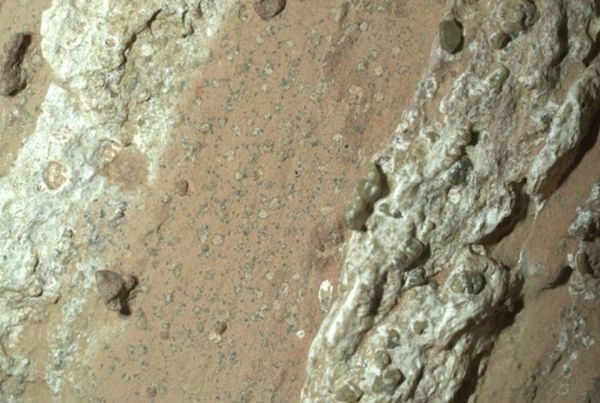
The latest supporting evidence comes from Perseverance, a mudstone containing chemically altered iron and organics. Here on Earth, sampling of similar mudstone points to the existence of mineral-eating microbes contained within the rocks. So, unless Martian chemistry works in ways totally alien to how chemistry works elsewhere in the Universe and here on Earth, the sole explanation for this discovery is we have found a Rosetta Stone equivalent that proves Mars was once alive.
Curiosity has also revealed chemistry in the sediments at Gale Crater which show lots of carbon-containing long molecular chains with fatty acids. On Earth, we would consider this to be evidence of past cellular life. Non-biological explanations may exist, but Occam’s Razor comes to mind. Curiosity’s combined with Perseverance’s discoveries suggest that the most likely explanation is true: past microbial life. When evidence from two places separated by thousands of kilometres produces results pointing to life, isn’t it time to admit that Aristotle was wrong?
Earth has never been alone in the Universe, certainly in the past, and probably in the present. In seeking further proof that Democritus was right, Part 3 will look at the evidence of alien life’s existence as revealed in recent asteroid sample return missions.
Stay tuned.