In Parts 1 and 2 of “Alone In the Universe,” we looked at UFOlogy and Mars. The first remains enigmatic. The second offers compelling evidence that Earth is not the sole crucible of life in the vastness of space. Now we can see the evidence from a small sampling of asteroids that reinforces the story that we are not alone, nor have we ever been.
Asteroid sampling missions already completed, two by Japan and one by the United States, are rendering Aristotelian Earth-centric thinking to the dustbin. A fourth one underway by China should produce a similar conclusion.
Democritus, Atoms and Life from Elsewhere
American and Japanese spacecraft visited Near-Earth Asteroids (NEAs) in this 21st century and have brought back sample evidence from their surfaces that contain organic matter. The two visited have no atmosphere or magnetic field. Yet, lying on their surfaces are raw materials for life, including nucleic acids and nucleobases found in RNA here on Earth. What got animated by a spark here on Earth and likely on Mars didn’t happen on these jumbles of rocks and space debris. The abundance of organic matter found locally here in the Solar System, however, suggests that life beyond Earth and Mars will be found to not be rare throughout the Milky Way and across the Universe.
Aristotelian thinking dominated our view of the Universe even though an earlier Greek philosopher, Democritus, got it right. He described all material things as consisting of elementary particles that he called atoms. Democritus saw everything in the material world as assemblies of these atoms. Life was just one piece of finished products coming from an assembly line. Death was its disassembly line.
It wasn’t until the 19th century that modern science rediscovered Democritus’ atoms. The existence of the atom and subsequent subatomic particles changed our relationship with the Universe forever. The fundamental building blocks for all material things were slowly revealed. From elementary and subatomic particles to atom bombs, the material Universe tells us that everything is interconnected. Atoms on Earth are no different from atoms elsewhere. So, if atoms can self-organize into base-pair nucleotides to form DNA here, why not anywhere?
Missions to Bennu, Itokawa, Ryugu and Other Near-Earth Asteroids
In the Solar System, 75% of known asteroids are called C types. This means they are predominantly made of carbon with small percentages of other rocks, minerals, and chemicals. Other types of asteroids include stony (S), metallic (M), and unclassified (U). Sub-categories further differentiate asteroid types. The alphabetical list includes A, D, E, K, P, Q, R and V-asteroids. Some of these are carbonaceous and others stony sub-categories.
Why sample asteroids? These small members of the Solar System date back to before the planets formed. Within them are the elements that eventually populated Earth, the other planets and their moons. They remain relatively unchanged from our beginnings in this part of the Milky Way. Included within them are the materials to create us.
Three sampling missions to NEAs have succeeded. Two originate from Japan and one from the United States. A fourth from China is currently underway. The asteroids in question include:
Itokawa
JAXA, the Japanese Space Agency, launched its Hayabusa spacecraft on a mission to this NEA in 2005 and successfully returned samples from its surface in 2011. Itokawa is an S-asteroid mostly made of silicate minerals. If you like granite, Itokawa is your asteroid of choice. Its subcomponent minerals obtained from returned samples include plagioclase, pyroxene, Olivine, troilite, taenite and chromite. When Japan’s Hayabusa visited it, the description given was of a pile of rubble with no solid surfaces.
Ryugu
Back in 2022, I wrote about Hayabusa 2’s sampling mission to this NEA. Hayabusa-2 was Japan’s second asteroid mission, producing exciting results upon its return of samples to Earth. Although the 2022 article was about the theory of panspermia, that life on Earth came from space, it noted the contents of Ryugu samples.
Ryugu turned out to be both carbon- and water-rich, with lots of hydrated minerals, including sulphides, phosphates, and organics, the latter of which included 20 different amino acids and uracil (a nucleobase found in RNA). Uracil’s presence suggests that C-asteroid impacts on early Earth could have delivered similar RNA building blocks to initiate the chain of evolutionary developments that led to life here. Could uracil have been made from non-organic sources? Maybe there is some interstellar chemistry we don’t understand to explain inorganic, abiotic formation of nucleobases, but it is more likely that right from the Solar System’s beginnings, before the planets, the elements for life were already present.
Bennu
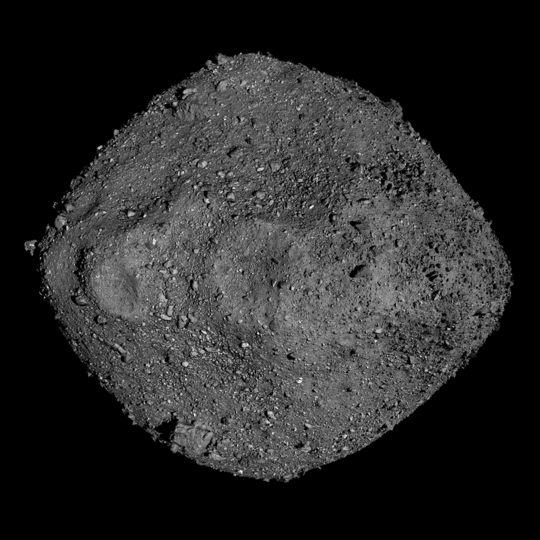
In March of this year, I wrote about OSIRIS-REx, the asteroid sample return mission to Bennu. The surface sample contained amino acids, nucleobases, ammonia, formaldehyde and traces of saltwater brine. The brine contained “thousands of organic compounds, including 14 of the 20 amino acids found in terrestrial organisms, as well as all the nucleotide bases that make up our DNA and RNA,” stated an article published in Scientific American, shortly after scientists released their sample findings.
The OSIRIS-REx spacecraft is not done yet. After visiting Bennu, it is now on its way to a second asteroid, Apophis, with the mission given a new name, OSIRIS-APEX and a rendezvous in 2029.
Kamo‘oalewa
China’s Tianwen-2 spacecraft, launched in 2025, is en route to the aforementioned NEA. It could be a fragment of Earth’s moon or a stray that arrived from the Asteroid Belt between Mars and Jupiter. The goal is to capture samples from the surface and return them to Earth sometime in 2027. It will be interesting to see if the contents of the samples reinforce what we already know from the three completed asteroid missions.
Asteroids and Mars Tell Us We Are Not Alone
From Mars and these asteroid missions, there appears to be a striking convergence. Evidence of past Martian life shows up in the ancient sediments and mudstones at the two sites that NASA’s Curiosity and Perseverance are still exploring. That’s just two sites with many more to explore in the future.
Meanwhile, asteroid sampling missions show that the nucleobases in DNA and RNA exist in primordial rock piles circling the Sun. The Bennu samples, in particular, contain 14 of the 20 amino acids that life on Earth uses to make proteins.
I’m certain future missions to asteroids, Mars and other Solar System bodies that test for present life, like those onboard the two Viking landers in 1976, will once and for all put the question of our being alone or not in the Universe to rest.