In episodes of Star Trek Voyager, spaceships in the 24th century, like the USS Voyager, featured biological computers. They were called bio-neural gel packs, embodying living brain cells embedded in a fluid-filled matrix designed to do complex problem-solving.
Well, it appears that the future is arriving sooner than the 24th century, with our ability today to engineer biology, blurring the lines between what is alive and what is not.
Bio-digital Convergence
Research into bio-digital convergence is going well beyond creating robots with humanoid characteristics, as today’s universities and computing companies work on:
- Synthetic organs.
- Living scaffolding that can grow and replace damaged joints.
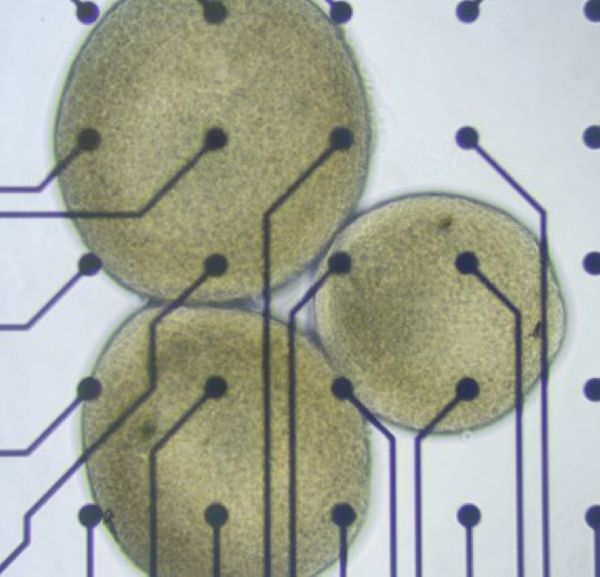
- Bio-circuits combining neurons and chips.
- DNA for mass data storage.
- Organs called organoids and organelles are used to test new drugs.
- Implanting living muscle cells for actuators in biobots.
New research is adding intelligent functionality to bio-hybrid designs. Lines of investigation are creating bio-implants that respond to the human body’s natural growth, mobility and strength.
It’s not the six-million-dollar man of science-fictional lore. In fact, it is something even better.
Pursuing Bio-circuits
For AI today, let alone regular computer systems, a big constraint is the power requirement. Human brains are far more energy-efficient than computers. An average adult brain uses 20 watts of power or less than a third of a kilowatt-hour (kWh) daily. It uses 25% of the energy to perform maintenance, and the remaining 75% for information processing.
To feed the brain’s daily energy requirements, the average human consumes about 260 kilocalories (kcal) daily. That’s between 10 and 13% of the total kcals consumed daily to maintain weight.
An average desktop computer, if left on for 24 hours, consumes between 1.5 and 12 kWh, depending on the work. High-end gaming desktops and data servers consume even more energy. Gamers can use as much as 16.8 kWh daily.
For energy comparisons between the biological and the electrical, 1 kWh equals 860 kcal, that more than 3 times greater than the chemical energy an average brain consumes daily.
Pursuing the Star Trek Dream Today
I share with you the work being done in biodigital convergence that recently caught my eye.
Northwestern’s Work on a Brain-Computer Interface
At Northwestern University, printed artificial neurons are communicating with human brain cells. Researchers have invented a device that interfaces with brain cells, demonstrating biocompatibility.
What have these researchers invented? It is a device containing synthetic flexible neurons fabricated using aerosol-jet printing. The device produces electrical pulses that match natural neuronal activity, triggering responses from living neurons.
What the researchers want to achieve is a brain-machine interface in the form of neuroprosthetics that can communicate with the nervous system to restore vision, hearing and movement.
Neuromorphic Breakthrough in Switzerland
A Swiss company, FinalSpark, has invented a bioprocessor using stem cells to build human brain organoids connected to neuromorphic chips. These organoids are kept in an incubator, keeping them alive for approximately 100 days. So far, the company has built more than 1,000 organoids to produce 18 terabytes of data.
The bioprocessor is almost a million times more energy efficient than current digital processors because the organoids are each a mini-brain. It operates in the cloud, serving as a living neuromorphic computing platform for AI and biocomputing applications.
FinalSpark’s ultimate goal is to build a living biocomputer that is scalable in size because you can add as many organoids as you like. The company sees it as a far more manageable computing platform for AI because of its low energy requirements.
Why Use DNA for Data Storage
Our final story today looks at deoxyribonucleic acid (DNA). We have only known about the double-helix molecule for 73 years. When first discovered, it changed our understanding of genetics.
By unravelling the double helix of nucleotides, we began to understand ourselves within the living world that surrounds us. Knowing about DNA made it possible for us to better diagnose diseases, develop new treatments, and begin to manipulate genetic information to our advantage. Knowing about DNA spurred the next agricultural revolution, producing the crops that today feed the world.
But there are more ways to use the molecule of life. One of those ways involves DNA for data storage, translating binary code into Adenine, Cytosine, Guanine and Thymine, the A-C-G-T nucleotides that make up the double helix. Data is encoded into a DNA sequence. Decoding turns it back into bits. The difference from current data storage to DNA storage is that the medium is biological rather than magnetic or optical. A gram of DNA can store a Petabyte (1,000 Terabytes) of data for hundreds of years while remaining stable throughout.
Consider the massive data storage and processing needs of today’s global digital economy, and the advent of artificial intelligence (AI), and you begin to see why DNA data storage makes sense. Data warehouses would take up no more space than a single desk drawer being built to facilitate AI, if converted to using DNA.
Challenges remain. These include:
- The medium is slow when reading and writing data.
- DNA synthesis and sequencing are pricey and, with current methods, prone to error.
- New electronics are needed to make DNA storage viable.
A positive is that the expanding capabilities of AI should help to overcome some of the DNA storage challenges. Meanwhile, new chips will be needed. Synthesizing DNA strands will need to be improved to reduce error rates.
Where will DNA storage be used?
It won’t be for local desktop computing. Instead, it will serve best for archival, long-term storage requiring data preservation for decades and even centuries.
How close are we to seeing DNA storage become a reality?
An alliance of academic and high technology companies have formed the DNA Data Storage Alliance. Companies include Twist Bioscience, Illumina, Western Digital, and Microsoft. Active research is being done at The Wyss Institute, University of Washington, EPFL, ETH Zurich, and imec, the latter a Belgium-based independent research and innovation centre. Wyss predicts the first pilot archival DNA storage system will be here before the decade is out.