
COP31 in Turkiye is running out of time this weekend, with a proposed final communique that fails to address the elephant in the room: phasing out fossil fuels.
These annual meetings have been going on for a long time. They attract the majority of countries and tens of thousands of attendees. Since the Paris Climate Agreement arising from COP21 in 2015, the nations of the world have done little to keep atmospheric mean temperatures from rising 1.5°C (2.7°F) above pre-Industrial Revolution levels.
The Pursuit of “Net Zero”
Another Paris objective was aimed at greenhouse gas (GHG) emission reductions, with 2050 as the voluntary date for compliance, where the nations at COP would achieve a balance between human-generated GHG emissions and removals, or “Net Zero.”
Instead, since Paris, GHGs continue to rise but at a slower pace than before 2015, with the only significant dip occurring during the first year of the COVID-19 global pandemic.
A Net Zero quote caught my eye recently. Guy Midgley, the Chief Academic Director for the School for Climate Studies at Stellenbosch University in South Africa, described what achieving Net Zero could do for the planet for the next million years. He stated:
“Because of the current pattern of Earth’s orbit around the Sun, the benign Holocene climate could remain broadly stable for up to another 50,000 years. If we achieve the Net Zero objective, we could unlock the potential for the longest interglacial period in more than a million years.”
Wouldn’t that be a worthy objective of COP meetings? Achieving Net Zero could create stable climate conditions in a geologically disruptive period that, as recently as 11,700 years ago, covered much of the Northern Hemisphere with ice sheets. The last peak of the ice age dates back 20,000 years, when, at most, there were only a few million of us on Earth, mostly confined to Africa and parts of Asia. At the glacial maximum, anthropologists estimate fewer than 6,000 humans were in Europe.
Climate Change Extremes
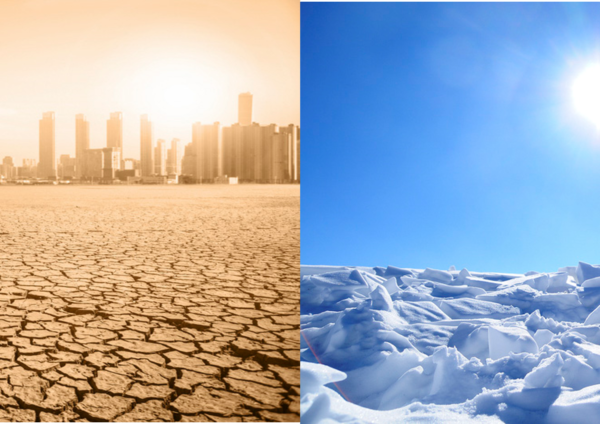
We could see two climate scenarios unfold in the centuries to come: a hotter world or a return to the ice age.
A Hotter World
In one, a world where atmospheric temperatures rise by 3°C (5.4°F) sometime between 2100 and 2150, would be fraught with extreme weather events that would become harder to recover from.
This world will see alpine glaciers vanish, a source of the world’s many rivers and freshwater for downstream nations. Permafrost melt would destabilize life in the Arctic. Equatorial rainforests in the Amazon and Congo basins would see major deforestation.
Ocean currents like the Atlantic Meridional Overturning Circulation (AMOC) would slow down or collapse, impacting fisheries, coastal and inland nations thousands of kilometres away.
Coral reefs, where much of the ocean’s biodiversity thrives, would experience severe die-offs. Where there are droughts today, the likelihood of desertification will grow.
In geological time scales, this period of overheating will be a blip. But on a human time scale, lasting for several centuries, it would be catastrophic.
A Colder World
One of the consequences of AMOC collapsing is a scenario where parts of the northern half of the planet would return to an ice age. Another potential cause of a colder world could come from human attempts at solar geoengineering. For example, filling the stratosphere and upper troposphere with aerosols released to block sunlight.
A return to ice age conditions would produce years without summers, and as ice grows, albedo feedback will further grow alpine and polar ice, which will persist.
Sea levels will fall as ice sheets grow. The Northern Hemisphere will see much of it depopulated as conditions become uninhabitable. Existing seaports will be marooned inland. Food systems will be disrupted. Precipitation patterns will change rivers, lakes and groundwater patterns. Agricultural challenges will grow, as will energy demands for heating.
Hundreds of millions will be displaced, intensifying the competition for diminishing resources. Nations as we know them today will likely not survive.
Will civilization collapse? Not likely, but our geopolitical world will be transformed. If the ice comes gradually, we will adapt incrementally. If an AMOC collapse is sudden, the destabilization of Europe and other parts of the Northern Hemisphere will create dangerous conditions as political institutions, mass migration, and shortages of housing, energy and food severely test human endurance.
Of these two scenarios, hot and cold, COP31 needs to pay more attention to the heat. At the same time, let’s hope that saner minds prevail among global leaders and big business (particularly fossil fuel energy company) heads to recognize that the wrong actions, like unproven geoengineering experiments, and a lack of action to reduce our burning of fossil fuels will lead to a destabilized future for humanity and the planet.