
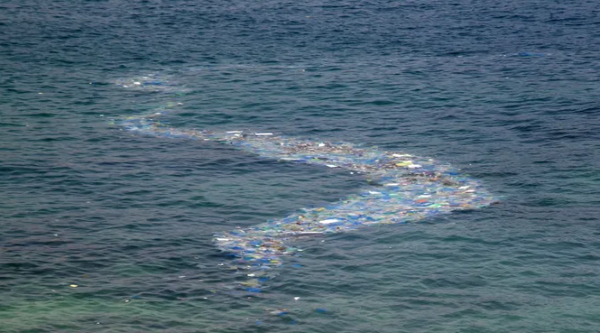
University of Bergen researchers recently reported that the growing concentration of microplastics in the Great Pacific Garbage Patch, an area twice the size of Texas, is contributing to a significant brightening of ocean waters. The microplastics are changing how light interacts with the ocean surface, both scattering and absorbing it differently to create an increasingly cyan tint.
Two articles appearing in November 2026 in the journal Nature note that the growing volume of microplastics over a 20-year record of satellite images shows distinctive changes in North Pacific Ocean water near the Garbage Patch. The authors of the article appearing on November 5, 2026, attribute this change to “multidecadal biogeochemical changes” caused by “a more than four-fold increase” in microplastics in the water column. In other words, the colour change isn’t natural.
Microplastics Confirm the Anthropocene is Here
The growing volume of microplastics in ocean water scatters blue-green light wavelengths, shifting the colour to cyan. Remarkably, this can be seen from space, where the suspended microplastics in the water column produce the effect. This observable fingerprint in Earth’s largest ocean provides more evidence that our presence on the planet is shifting us from the Holocene geological epoch, which began with the retreat of the last Ice Age, to one influenced by humans, the Anthropocene.
Up until now, evidence that humans were a recognizable geological force on Earth was linked to:
- Spikes in radioactivity from 1950s atmospheric nuclear weapons tests,
- Industrial contaminants including plastics, concrete, fly ash and other human-generated materials found in soil and beach sediments,
- Forever chemical pollution,
- Natural habitat loss and extinction events,
- The growing presence of our human population and terrestrial biomass of domesticated livestock.
Microplastics are Everywhere Today
The persistent presence of microplastics in the open ocean is alarming because it shows how much of the stuff is being dispersed by our addiction to plastics since we first started churning the stuff out in the mid-20th century.
Think of it! In 75 years, we have created so much plastic that degraded volumes of it, amounting to 5 milligrams per cubic metre, are changing the colour of parts of the Pacific Ocean.
According to data collected by the United Nations, humanity produces 430 million tons of plastic annually. When it degrades, it turns into microplastics. With the ocean as the last repository of everything we flush down the toilet, microplastics represent a significant threat.
A recent article appearing in Oceanographic Magazine described how microplastics were being linked to a decline in the ocean’s ability to absorb carbon dioxide (CO2). Considering the ocean is Earth’s largest natural carbon sink, that news is particularly alarming.
Where else are we finding microplastics?
- A September 2025 study in Biomedical Engineering Letters detected microplastics in 17 of 22 healthy blood donors, amounting to 1.6 micrograms per millilitre.
- A study published in Nature Medicine in February 2025 reported microplastic accumulations in human brains.
- A 2024 editorial in Nature Medicine that described growing evidence of microplastics found in breast milk, liver, lungs, reproductive organs, cardiovascular and nervous system tissues.
It shouldn’t be a surprise to find out that microplastics today are detected in seafood, milk, packaged foods, and of course, bottled water.
Those plastic bottles people walk around with to stay hydrated contain dramatically higher levels of microplastics than tap water. A January 20, 2026 article published in the journal Toxics, entitled “From Kitchen to Cell,” reviews the pervasive presence of microplastics in common sources from “food packaging, kitchen utensils, and household appliances” with links to human health risks.
Today’s Indispensables, Tomorrow’s Heart Attack
We ingest a lot of plastic. In 76 studies, the estimated amount of microplastics ingested daily can be up to one million particles. This long-term exposure has health implications for us:
- cellular toxicity,
- oxidative stress,
- gastrointestinal inflammation,
- microbiome disruption,
- respiratory disease and lung fibrosis,
- sperm dysfunction,
- blood clotting and thrombosis,
- heart attack and stroke.
Maybe those satellite images of a cyan ocean tell us it is time to put our house in order here on Earth or face the consequences of our plastic addiction.