
Fuel cells have been around for almost a century. The first working alkaline fuel cell using nickel and platinum anodes and cathodes was demonstrated in 1932. The first hydrogen-nickel fuel cell appeared in 1959. Fuel cells found a home with NASA during the space race because they produced electricity for the Gemini and Apollo spacecraft as well as the Space Shuttle. The byproduct water could be drunk by astronaut crews.
Geoffrey Ballard saw the potential of fuel cells. His Canadian company, Ballard Power Systems, put the first fuel cells into pilot projects in buses, passenger vehicles and even submarines. But chronically short of funding, Ballard fuel cells never commanded the transition away from fossil-fuel-powered cars to electrification, and instead found specialty vertical transportation applications.
What held the technology back was the cost of platinum catalysts, hydrogen production and storage, competition from batteries, and a reluctance for the market to abandon gas and diesel vehicles.
Now, fuel cells are finding stationary power, military, remote and niche consumer uses as electricity demand continues to grow while decarbonization moves business and industry away from burning fossil fuels.
A recent IDTechEx forecast expects to see global fuel cell demand grow dramatically, including a stationary market expected to reach US $11 billion by 2037.
What fuel cell technologies are expected to fulfill this demand?
- Solid oxide fuel cells (SOFCs).
- Proton exchange membrane fuel cells (PEMFCs).
- Phosphoric acid fuel cells (PAFCs).
- Alkaline fuel cells (AFCs).
- Molten carbonate fuel cells (MCFCs).
- Direct methanol fuel cells (DMFCs).
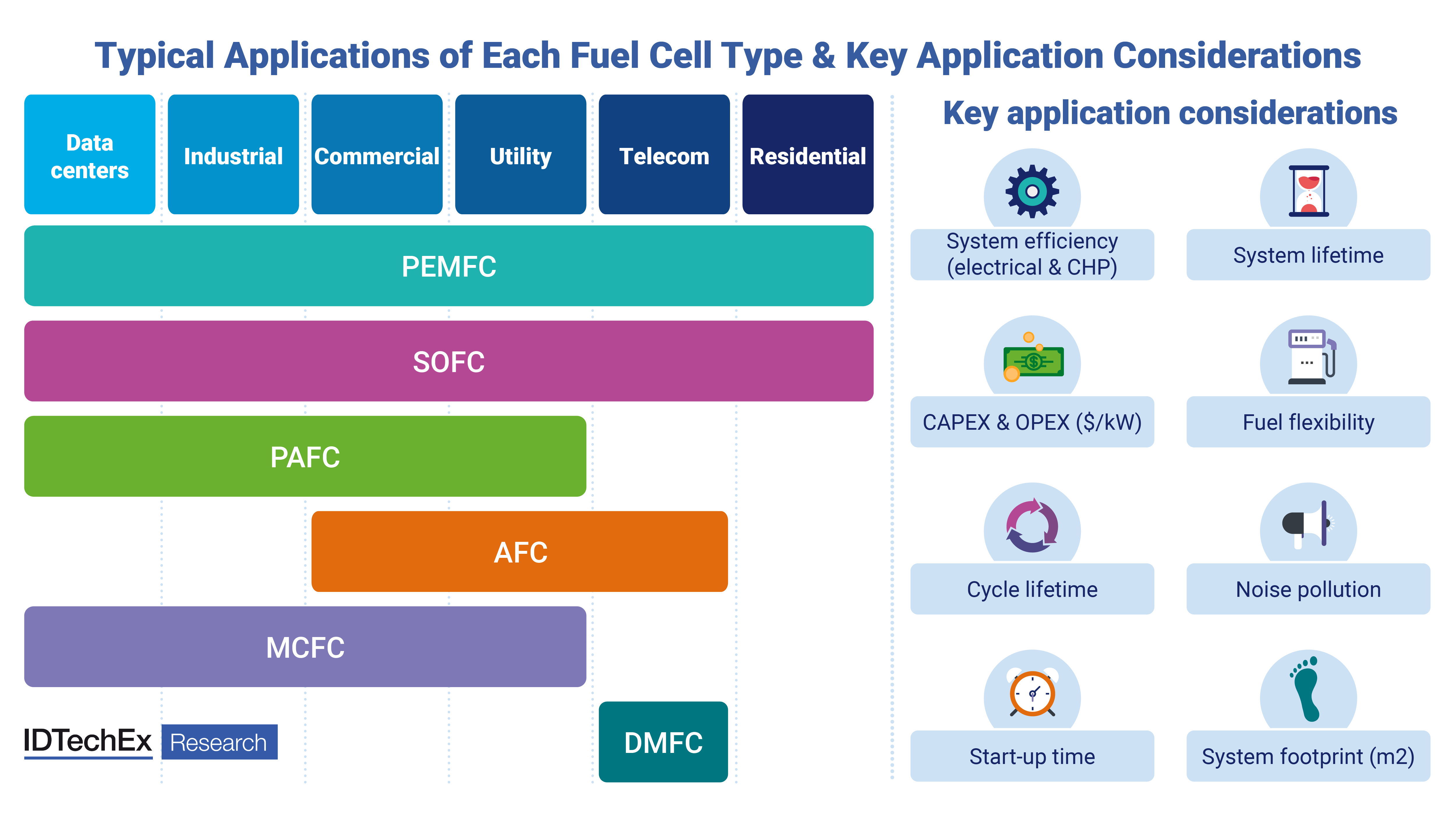
Overview of the typical applications for each fuel cell type and key application considerations. (Image credit: IDTechEx)
Data Centres Represent the New Stationary Fuel Cell Market
The energy demands required by artificial intelligence (AI) frontier applications are spurring a rapid growth in data centres. Demands of cloud computing have already stressed the existing energy grid. Now AI is adding to the demand and making grid connections harder and necessitating the need for local electricity production where fuel cells can prove a reliable alternative.
In addition, utilities are looking to install fuel cell systems to provide additional onsite capacity to feed into the grid. Compared to building peaker plants, usually natural-gas thermal mini-power plants, fuel cell stacks can reliably add electricity capacity when needed.
Different Fuel Cells Serve Various Application Needs
The primary fuel cells for stationary implementation are PEMFCs and SOFCs. Each serves different uses. PEMFCs are good for local power backup systems in the event of grid failure. SOFCs are suitable
PEMFC
PEMFCs are best suited for backup power applications, where rapid response and high-power density are important. They provide a low-emission alternative to diesel generators, and support growing interest from commercial and critical infrastructure operators. However, larger-scale PEMFC deployment remains closely linked to the availability and cost of high-purity hydrogen. The slower development of the green hydrogen market remains a key limitation to scaling up PEMFC deployment.
SOFC
These fuel cells are best suited for primary baseload power generation. Their high electrical efficiency and fuel flexibility make them suitable for continuous power generation, while operating temperatures above 650°C (approximately !,200°F) make them suitable for converting natural gas into hydrogen. This means they provide a flexible fuel infrastructure for today that can transition as the world moves toward net-zero emissions.
PAFC
These fuel cells have been in commercial use since the early 1990s. They operate at temperatures between 150 and 220°C (approximately 300 to 430°F), making them suitable for local water and space heating for homes and industrial spaces. These cells are heat-producing heavyweight workhorses and not considered suitable for mobile applications.
AFC
These cells use an alkaline electrolyte to produce electricity, water and heat. They work best with hydrogen and oxygen and operate at temperatures between 60 and 100°C (140 to 212°F). They were used for the Gemini and Apollo spacecraft and the Space Shuttle, with the byproduct being water used for drinking by astronaut crews.
MCFC
These high-temperature cells use a mix of molten lithium and potassium carbonate salts as electrolytes. When heated to between 600 and 700°C (approximately 1,110 to 1,300°F). Primary use is for stationary power generation in industrial and power plant applications.
DMFC
These low-temperature fuel cells convert liquid methanol and oxygen into electricity, water and carbon dioxide. They can come in small form factors suitable for battery chargers, remote sensors, portable electronics, emergency equipment, telecommunications and small vehicles such as forklifts.
Fuel Cells vs Batteries
In the battle for electrified transportation, batteries have been winning over fuel cells. Why? It has more to do with the maturity of the vehicle battery industry than the efficiency differences between the two technologies.
Fuel cells, however, have distinct advantages. In vehicles and other applications, refuelling is fast. Fuel cells have greater energy density. As such they they generate more power per kilogram than batteries. Fuel cells don’t suffer degradation when refuelled, unlike batteries that lose efficiency and storage capacity over time. Fuel cells operate in all kinds of weather, whereas batteries prove to be less efficient in cold climates. Finally, fuel cell material requirements are readily available, while rare earth materials needed for batteries can sometimes be supply-constrained.
As for fuel cell vehicles vs. electrified transportation, finding hydrogen pumping stations, when compared to the growing number of recharging sites, will continue to keep fuel cells from wider adoption.