
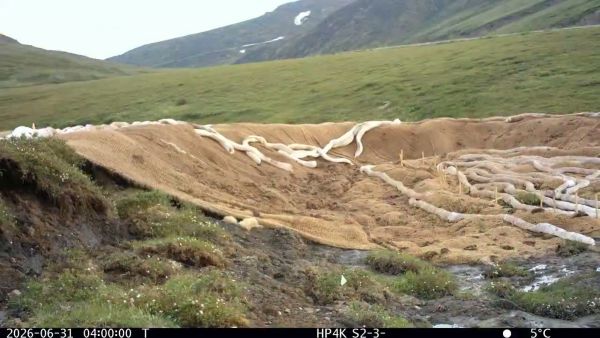
The idea of covering permafrost with a blanket so it doesn’t thaw and release carbon dioxide (C0₂) and methane (CH₄) into the atmosphere is being tested by a Canadian startup, PermaC. The company is laying wood chips, soil and native Arctic plant seeds on top of Arctic permafrost, and then covering these areas with coconut-fibre mats. The mats, in theory, insulate the ground to impede thawing.
That we have come to this as a solution for global warming indicates that we collectively have failed to mitigate climate change by cutting our greenhouse gas (GHG) emissions.
The Permafrost Threat
Permafrost is the frozen ground that rings the northern part of our planet north of the 60° parallel of latitude. This covers most of Alaska, Canada’s Yukon, Northwest Territories and Nunavut, Greenland, Scandinavia and Northern Russia from the Kola Peninsula through Siberia.
Within it, there is lots of water and vast stores of decaying organic material. In other words, lots of carbon.
In the last half century, the Arctic has warmed at twice the global rate, and since 1980, the rate has tripled. The current rate of Arctic atmospheric warming comes out to 0.7°C (1.26°F) per decade.
How do we know these numbers are accurate? The data comes from NASA Earth observation satellites, NOAA, and Canadian, Russian and Scandinavian sources.
As the Arctic warms, so does the permafrost and, with it, the release of C0₂ and CH₄, two potent GHGs, into the atmosphere.
NOAA estimates that contained within the Arctic permafrost is 1.5 trillion tons of carbon, or two times the amount currently in the atmosphere. As the world warms, permafrost could release hundreds of billion tons more in the form of C0₂ and CH₄.
That’s not all. For communities in the north built on permafrost and for areas where frozen ground touches the Arctic Ocean, erosion, landslides, and slumping of the land are increasingly common. Whole communities today are pulling up stakes and moving to more stable ground as the permafrost melts.
PermaC’s Hail Mary
A 2026 pilot this summer in the Canadian Northwest Territories demonstrated PermaC’s solution, the Green Blanket. The company field-tested its solution over actively thawing permafrost. It measured the changes to the land surfaces under the Green Blanket versus untreated neighbouring land. A time-lapse video compares the rate of slumping under the Green Blanket versus exposed land. Survey drones, LiDAR, GPS, and ground temperature and moisture sensors were deployed as well. The intervention worked as intended. Erosion was zero under the Green Blanket, while the untreated land slumped 5 metres. Temperature readings beneath the blanket remained stable at 0°C (32°F), while the untreated land saw increases to 20°C (68°F).
Of course, covering all Arctic permafrost is impractical. However, where Arctic communities already exist, a Green Blanket can address the threat of land subsidence, slides, and slumps. This will help stabilize vulnerable surfaces and protect above-ground infrastructure, including roads, homes, and utilities.
Stopping the thawing of the permafrost will also keep the land and soil stable, preventing contamination from sewage and sediment that wash out into rivers and freshwater sources.
A Green Blanket selectively applied won’t solve climate change. It will, however, by preventing thawing, reduce GHG emissions, and by stopping erosion near and in urban settlements, save Arctic communities tens of billions of dollars from having to repair critical infrastructure.
Is the Green Blanket Geoengineering?
Some would argue that PermaC is performing the same kind of service as the Dutch boy who plugged a hole in a dyke with his finger to stop a flood. Unless its Green Blanket can be made large enough to cover the entire permafrost, it will not stop global warming. Instead, it will help communities and life in the Arctic selectively adapt to climate change.
As a technical solution to stop more carbon from getting into the atmosphere, it will have minimal impact at best.