
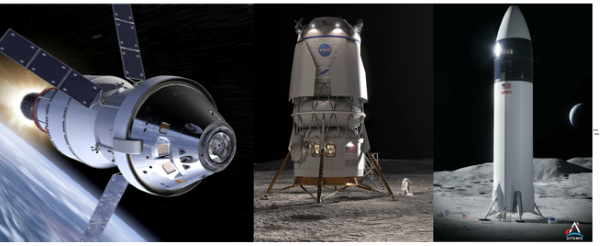
In the last week, NASA announced what’s planned for Artemis III in the summer of 2027. The agency admitted the schedule has slipped by 90 days but is still aiming for the summer 2027 window.
At that time, NASA will launch its Orion capsule atop the SLS (Space Launch System) megarocket. The goal is to perform orbital manoeuvres and the rendezvous and docking with the two commercial partners contracted to deliver lunar landers, the human landing systems referred to as HLS. The two will be launched to low-Earth orbit (LEO) for Orion and its crew to prove the systems being designed for Artemis IV, the return to the Moon, this time at the south pole in 2028. Artemis III is scheduled to last between 14 and 17 days.
Three Big Launches of Three Big Rockets
The sound and light show from Cape Canaveral will involve three rockets from different suppliers. The launches will be sequential. First, preceding Orion’s lift-off, Blue Origin’s New Glenn (a partially reusable rocket launch system) will deliver its Blue Moon Mark 2 HLS to LEO. Blue Moon will remain in orbit for up to a month, flying at an altitude of 440 kilometres (273 miles) above Earth. Its systems will be fully tested.
Orion will follow the New Glenn with an SLS launch. Four astronauts will be onboard. Orion will go into an elliptical orbit before manoeuvring into a circular orbit 555 kilometres (345 miles) above Earth. From there, it will navigate to the Blue Moon, rendezvous and dock. The plan calls for this to happen on the third day of the mission.
Two of four astronauts will transfer back and forth from the Orion to the Blue Moon to test the combined systems, life support and other critical functions, certifying its readiness for future Moon missions. The Blue Moon is currently slated to be the HLS for Artemis V. Once fully checked out, the astronauts will return to the Orion and undock from the Blue Moon to wait for the third act in this drama: the launch of the SpaceX Starship HLS and subsequent rendezvous and docking.
Starship HLS is a modified version of the ship that SpaceX has been flying for the last two years as it undergoes testing. The last Starship in its 14th launch achieved LEO for the first time. November will see a 15th Starship flight where SpaceX intends to demonstrate full reusability, recovering both the ship and super heavy booster.
The SpaceX HLS sitting atop the first stage Super Heavy booster will launch as early as the sixth day of the Artemis III mission. It will go into orbit at 381 kilometres (237 miles), waiting for Orion to rendezvous and dock. That manoeuvre will occur on day 8 of the mission. No crew transfer is planned. Instead, the two spacecraft will be tested to see how they perform in flight.
After undocking, the remainder of the mission will include assessing the viability of Orion and all its systems in preparation for Artemis IV. Besides emergency and life support tests, the astronauts will give their new Artemis-designed spacesuits a workout.
What Still Has to Happen Before Artemis III Flies
Both commercial partners are working at a feverish pace to complete the two versions of HLS. NASA has turned this into a competition. Whichever is first to go and demonstrate its viability will be the landing system used for Artemis IV.
Blue Origin faces the challenge of having never used the Blue Moon before. For those who are familiar with how the Apollo missions worked, a command module, a lunar excursion module (LEM) and the Saturn V rocket launcher, the flight to the Moon using Blue Origin technology will seem somewhat familiar. Two differences stand out. One is the Blue Moon lander, which will be launched separately from the Orion command module. Rendezvous and docking will occur in LEO before a translunar burn sends the two off to the Moon. Once there, the Blue Moon will descend to the surface. Upon return to rendezvous and dock with the Orion before the latter sets off for home, the Blue Moon will be left in a parking orbit around the Moon to wait for the next Artemis mission.
SpaceX’s plan is more complicated. To get NASA’s green light for Artemis IV, the company will have to demonstrate a key milestone: successful refuelling of the HLS in orbit.
SpaceX will have to demonstrate this capability by launching two Starships to LEO. One will be the ship, the other a tanker filled with fuel. A fuel transfer will be performed. The demonstration is set for early 2027, before Artemis III flies. The ships will launch from two different sites, one in Texas and the other in Florida. They will rendezvous and demonstrate orbital refuelling, a critical step for SpaceX in its plans to expand space travel to cislunar space and eventually Mars.
The race between Blue Origin and SpaceX is on. Artemis III should give us a winner for who gets back to the Moon first in 2028.