
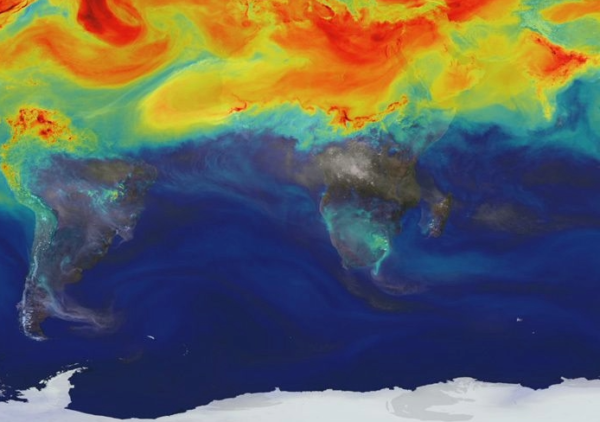
To reverse global warming, rising levels of greenhouse gases (GHG) need to be removed from the atmosphere. Despite annual global meetings sponsored by the United Nations to address atmospheric accumulations, human-generated carbon dioxide (CO₂) and methane (CH₄) continue to rise.
The cumulative effect to date from the beginning of the Industrial Revolution in the mid-19th century amounts to nearly a trillion tons of CO₂ or equivalent GHGs. Climate scientists conservatively estimate that historic accumulations of the two gases have contributed to a mean surface warming of the planet by 0.45°C (0.8°F).
Why are climate scientists quoting much higher global warming numbers than 0..45°C? Because CO₂ is only one GHG contributor. Others include CH₄ (which causes short-term spikes in temperature rise), nitrous oxide (N₂O), halocarbons, ozone pollution, and increased water vapour. Then add the recurring El Niños, and global temperatures are exceeding the temperature rise attributed to just CO₂.
Warming Appears to be Accelerating
In 2024, the World Meteorological Organization (WMO) estimated global temperatures were between 1.34°C and 1.41°C (2.41°F to 2.54°F) higher than the mid-19th century. The report also noted that, averaged over several decades, the rise was accelerating.
The reason cited for this is human behaviour. We keep adding more GHGs to the environment faster than nature can absorb.
In 2024, the report noted that CO₂, CH₄ and N₂O had reached modern record levels. The more the atmosphere heats, the more it adds heat-trapping capacity.
- Warmer air holds more water vapour.
- Warmer air melts glaciers and sea ice, the latter exposing darker ocean water that absorbs more sunlight, converting it to heat.
- Warmer air melts permafrost, releasing more CO₂ and CH₄.
- Warmer air contributes to a rise in wildfires that add more CO₂ to the air.
At current rates, warming is increasing 0.27°C (0.49°F) per decade.
A Geoengineering Solution Means Removing GHGs
The two biggies in terms of GHGs are CO₂ and CH₄. This can be done through technology or by natural means. The following list includes the various ways GHGs can be removed.
Direct Air Capture (DAC)
DAC involves absorbing CO₂ from ambient air and capturing it to permanently store it underground in geologically stable environments. It is expensive, with a number of companies demonstrating small-volume successes to date. These include Climeworks, 1PointFive, Heirloom Carbon Technologies, CarbonCapture Inc., and Deep Sky. Totals for CO₂ removed and stored have yet to reach 10,000 tons. Optimistic forecasts could see a half million tons removed in 2027.
Afforestation and Reforestation
This involves planting lots of trees to absorb CO₂. Trees use CO₂ during photosynthesis and turn it into lignin and cellulose. Until cut, the CO₂ is sequestered. Forests also store carbon in soils.
N ew forest growth and reforestation projects in 2026 are not keeping up with deforestation from logging, the clearing of land for agriculture, and wildfires. Governments through the UN have pledged to restore 1 billion hectares (2.47 billion acres) of forests by 2030. That is an area equal to the size of the U.S. and Canada combined.
Biomass and Biochar
This includes creating biomass from land and natural marine carbon sinks such as dense forests, mangroves, salt marshes and seagrass.
Creating biochar involves an industrial process called pyrolysis, which can turn agricultural waste into stable charcoal for sequestration.
Natural biomass methods of storing carbon are cheap and easy to scale. To date, they represent 85 to 90% of the CO₂ being removed from the atmosphere. In 2026, biochar carbon removal contracted volumes in 280 projects reached just under 3 million tons. The technical potential is estimated to reach between 0.44 and 2.62 gigatons of CO₂ by 2030.
BECCS
The acronym stands for Biomass Energy Carbon Capture and Sequestration. It involves growing biomass to use to generate energy while at the same time capturing the resulting CO₂ emissions and sequestering them.
BECCS is being done at an industrial scale at one operation, Archer Daniels Midland (ADM) in Decatur, Illinois, capturing up to one million tons of CO₂ annually from corn-to-ethanol fermentation.
Other players include Red Trail Energy, BioCirc and Husky Energy. Technology companies are pre-purchasing millions of tons for carbon credits. Microsoft is working with Stockholm Exergi in Sweden, handling 800,000 tons of captured CO₂ annually, and with AtmosClear in Louisiana to handle 680,000 tons of captured CO₂ per year.
Drax Group in the UK is converting a power station to capture 8 million tons of CO₂ annually using BECCS.
Rock Weathering
This involves grinding up shales and sandstone and adding CO₂ in aqueous form to create limestone for permanent carbon storage. The process is designed to speed up something that happens naturally.
Companies are enhancing weathering by grinding up basalts and spreading them over agricultural land, where rain dissolves the CO₂ in the air and creates a chemical reaction that binds the carbon.
Companies working on enhanced rock weathering include UNDO Carbon, a recent $100 million XPrize Carbon Removal winner, InPlanet, Lithos Carbon, Terradot and Mati Carbon.
Current carbon credit purchases from rock weathering carbon capture amount to 1.1 million tons.
OAE
The acronym stands for Ocean Alkalinity Enhancement and is designed to neutralize ocean acidification as more CO₂ gets absorbed by seawater.
Methods for OAE include adding iron to create biomass or calcium to enhance the binding of CO₂ with minerals to form stable permanent storage in the form of rocks. Another method uses electrodialysis with ocean water to offset increasing levels of absorbed CO₂.
A number of unauthorized tests of OAE continue to occur, mostly by universities. Two commercial operations include Planetary Technologies and the Vesta Project. Both are dumping iron-containing sands into the ocean to create bicarbonate and carbonate ions and increase pH levels. Locking carbon this way lets the ocean continue to absorb CO₂ without getting more acidic. The sequestration of carbon is expected to be stable up to 100,000 years.
For electrodialysis, which adds nothing to seawater while rearranging its molecular structure, water is split into highly alkaline and acidic streams, with the latter getting stripped of its CO₂, and the former being returned to the ocean. A more alkaline ocean can absorb more CO₂.
Ebb Carbon and Captura are two tech startups hoping to turn this into a business, locating operations near desalination and wastewater processing plants.
Methane Removal
CH₄ removal is harder to do than removing CO₂ because there is far less of it in the atmosphere and it doesn’t endure beyond 20 years. The goal, therefore, is to accelerate its oxidation and turn the gas into CO₂ and water vapour.
Because the amount of CH₄, by volume, is so small, companies are in the business of removing the gas from the places where it is created in volume. These include mines, dairy farms, landfills and primary industries.
The technologies deployed include thermal catalytic reactors, atmospheric oxidation enhancement, ecosystem uptake and turning infrastructure into passive methane collectors using photocatalytic coatings.
The who’s who of CH₄ removal includes Windfall Bio in California, Ambient Carbon in Denmark, M2X Energy, and Canada’s Kathairos Solutions.
One novel project called ZELP (Zero Emissions Livestock Project) has created wearable harnesses for cattle to capture the CH₄ in cow farts.
A Stanford and Chalmers University joint study noted that removing 3 years of human-sourced CH₄ could lower global atmospheric temperatures by 0.21°C (0.38°F). Total removal of human-generated CH₄ would reduce warming by 0.7°C (1.26°F).



 from the atmosphere using natural and technological fixes.)