
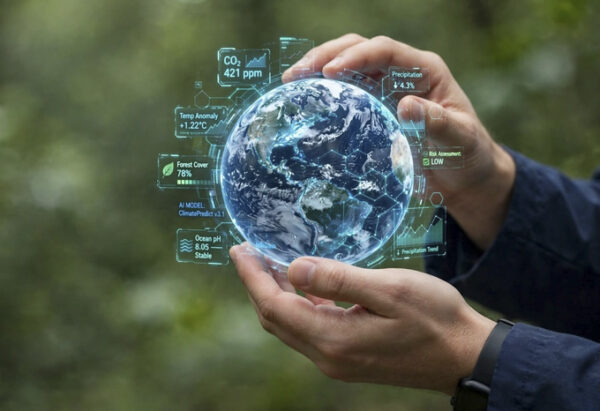
In Parts 1 and 2 of this series on geoengineering climate change, we looked at addressing permafrost melt and sucking greenhouse gas (GHG) emissions from the air. In Part 3, we get to look at how artificial intelligence (AI) can help turn back the global warming threat, using the technology to save ourselves.
AI and Climate Change – What’s the Fit?
An article in National Geographic by Jackie Snow, titled “How artificial intelligence can tackle climate change,” was among the first I read, suggesting that AI, rather than contributing to global warming, could help mitigate and adapt to it.
Written in 2019, Snow’s article described how researchers at the University of Pennsylvania used machine learning (ML) to examine energy production, carbon dioxide (CO₂) removal, education, solar geoengineering, finance, and more, drawing on datasets from climate modelling and climate informatics.
Since this article first appeared in 2019, AI has undergone a rapid transformation. ML has been joined by Large Language Model (LLM) AI, and seven more years of data collection with additional, more sophisticated climate models.
LLMs can be used today to study the vast amounts of data being collected each day, coming from the electrical grid, power production, buildings and homes, transportation, and industry.
AI, the Electrical Grid and Power Production
The obvious climate solution involving the electrical grid is a transition to renewable energy sources. How can AI help us get there?
AI is energy dependent. Without electricity, we wouldn’t have it.
AI is also an energy hog. The rapid growth in demand for data centres makes AI a contributor to climate change.
So, what can AI do to reverse this?
AI, particularly LLMs, feed on vast amounts of data. The power grid generates tons of information daily. Getting LLMs to digest this data should lead to identifying where the grid wastes power and where electricity needs to be delivered. That’s because studying the data allows AI to forecast, optimize and control the flow from generation to storage and distribution.
AI can integrate variable renewable energy sources by studying weather and satellite data, knowing where and when the wind is blowing and when the sun is out. It can optimize renewable energy inputs rather than waste them, a process the industry calls curtailment.
AI applied to weather forecasts will help maximize the use of renewables and lessen the need for natural gas, oil, and coal-fired thermal power plants. Knowing weather patterns will allow AI to optimize power transmission line loads based on wind, temperature and other conditions.
In its assessment, the International Energy Agency (IEA) describes the transformative potential of AI for the power grid as being revolutionary.
AI, Buildings and Homes
We need to have places to live and work. Buildings, homes and the construction industry consume 32% of global energy demand and produce between 34% and 37% of all human-generated CO₂ emissions. Housing contributes between 17 and 21% to global GHG emissions.
The footprint of construction includes embodied carbon, the emissions produced before project completion involving raw materials, manufacturing, transportation, as well as demolition and disposal. Material and process-related emissions alone account for 11% of produced GHGs.
Where can AI help us to make the buildings and homes we produce contribute less to climate change?
- Addressing embodied carbon – from site location to low-energy demand designs and material use, AI can assist at every stage in a building or home’s life with low-carbon material choices based on accessibility, the use of low-carbon concrete, wood, mass timber, recycled steel and other reused materials.
- Managing building operations – commercial and residential buildings can use AI apps designed to audit and find energy savings. AI apps that study demand and usage of HVAC, elevators and other building systems can reduce building operating costs and GHG emissions.
- Managing home energy and other operations – AI apps can analyze usage patterns to pre-cool or pre-heat interiors based on occupancy. AI can regulate the use of in-home power generation from rooftop solar and battery packs, and optimize EV and other appliance charging during low-demand periods, lowering energy costs and GHG emissions.
AI and Transportation
Transportation’s share of GHG emissions is about 15%. That includes land, air and marine sources. Road vehicles are the largest contributors, about 75% of the sector’s CO₂ emissions. Aviation (particularly air cargo) comes next, followed by marine shipping, with pipelines and rail last.
NAVIT is a mobility budgeting and management website designed to help companies with transportation costs. It has collected interesting data on emission contributions, comparing different transportation modes and the amount of CO₂ emitted per passenger per kilometre. In order from greatest to least, commercial passenger airplanes emit 238 grams; an average car emits 166 grams; passenger ferries, 123 grams; local bus transportation, 93 grams; subways and streetcars, 63 grams; and long-distance trains and buses, 31 grams.
For practical purposes, it becomes obvious that GHG emission reductions can immediately be achieved by changing how we move people and goods from place to place. So where can AI help beyond humans making lower-emission transportation choices?
According to Deloitte, where AI can be used in transportation covers a wide range of applications focused on data-driven optimization:
- AI can assist urban mobility by combining data from street cameras, global positioning systems (GPS), weather forecasts, transit feeds, and connected-vehicle data networks to manage congestion, signal timing, and routing.
- AI predictive-maintenance apps in vehicles of all kinds can make them self-monitoring and able to anticipate needed interventions before parts fail; and transportation infrastructure can include smart sensors in roads, bridges, railway and subway tracks, and air and sea ports.
- AI apps can improve logistics for air, rail, truck and marine transportation that match freight to available capacity and optimize routes.
AI and Industry
The best way for industry to combat global warming is through decarbonization. There is no substitute for cutting emissions from the burning of fossil fuels. Where can AI serve to optimize decarbonization?
- AI apps built into industrial processes, systems and logistics can assist with design, material selection and supply chains to reflect low-carbon choices.
- AI can optimize energy usage to minimize emissions.
- Smart sensors can provide preventive maintenance and improve production processes.
AI and Scary Geoengineering
Everything described above, strictly speaking, doesn’t fit the traditional definition of geoengineering. The effective implementation of these strategies, however, would reduce GHGs. This would draw down emissions to net-zero to stabilize and eventually lower atmospheric temperatures.
In Part 2, the sucking of CO₂ and methane (CH₄) from the atmosphere fits the geoengineering definition. But there are other technological solutions that have been proposed to achieve planetwide climate change.
In Part 4, we will tackle the remaining few where adding AI could prove useful. What are we talking about? All of these fit under the category of solar radiation modification (SRM). From the lower atmosphere to space, these include:
- Changing the dynamics of the troposphere by altering the reflectivity and thickness of various types of clouds.
- Changing the composition of the stratosphere through aerosol injections.
- Deploying a constellation of planetary sunshade satellites to block a portion of incoming sunlight.