
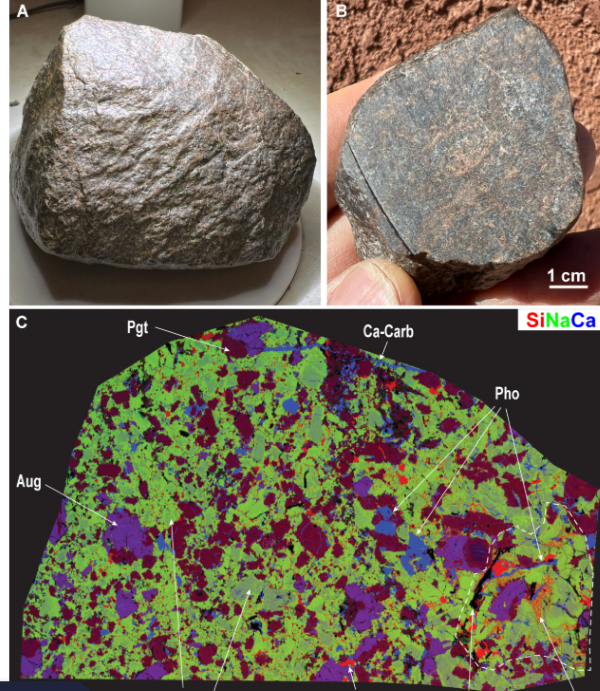
One of the people who reads the 21st Century Tech Blog sent me a November 1, 2026 article from the Washington Post about a newly identified Martian meteorite found in the Sahara Desert.
Scientists who cracked the rock open published findings in the online journal, Science, on October 29, 2026. It caught the attention of the Washington Post reporter, who got my reader interested enough to forward it to me. I searched for the journal article and found it (Click on the highlighted text to find the article in full).
Given the name Teghaza 001, or Teg 001, the Martian rock was found in Mali in 2022. It consists of a slowly cooled igneous rock formed from Martian lava 4.1 billion years ago. Its composition is geochemically distinct and includes the presence of water-altered minerals.
This suggests the Martian surface included places where water gathered 4.1 billion years ago. It also illustrates how the planet’s surface was subjected to heavy bombardments, with one of those strikes so forceful it ejected the Saharan-discovered rock into space, where, over time, it made it to Earth.
Martian Meteorites: Different Flavours for Different Dates
Most identified Martian meteorites are classified as shergottites (largely basalt), amounting to 82% of all discoveries, nakhlites (pyroxene), the second largest at 14%, and chassignites (olivine), the smallest sample size at 3%. These Martian rocks found here on Earth are dated between 2.4 and 1.3 billion years old.
Teg 001, however, is different. It is one of only two discovered here that is over 4 billion years old. The other one is estimated to be 4.3 billion years old. Together, the scientists who wrote the article believe the two can help build a picture of early Mars’ crust and mantle conditions. They do acknowledge, however, that large gaps remain in understanding the planet’s early evolution.
Where to Find Martian Rocks
Although meteorites can strike anywhere on Earth, the bulk of them are found in cold and hot deserts: Antarctica, the Sahara, the Arabian Peninsula, the Gobi and Central Australia, where they can be more easily spotted. Of those that have been found, few have witnessed their fall to Earth. So, we find them well after they arrived and have been subjected to Earth’s environment, which further alters their composition.
How do they get from Mars to here? From the visible evidence of craters on the Martian surface, we know the Red Planet has been bombarded heavily throughout its history. Asteroid and comet strikes in the early history of Mars, just like Earth, were common.
To launch a piece of Mars from the surface, however, requires a forceful strike capable of creating ejecta that achieves escape velocity from the planet’s gravity well. That escape is no mean feat.
The impact has to be violent enough to both pulverize and melt the ejecta while it accelerates it from the surface at high speed. The pressure wave exerted during acceleration further alters the ejecta’s texture and consistency, while the flight through the atmosphere traps some of its gases before reaching outer space.
Not many rocks make it, and once they do, they could end up circling Mars for centuries before their orbits decay and bring them back to the surface. Some of the rocks, however, escape to orbit around the Sun. From there, they experience other gravitational forces from Solar System bodies that push them into intersecting Earth, where they get pulled by our planet’s gravity.
While in space, the Martian rocks are exposed to cosmic rays and other extremes of the space environment, further altering them. The final stage of the journey involves a fiery descent through Earth’s atmosphere to the planet’s surface. The trip can take millions of years.
How Do We Know We Have Martian Rocks?
I tend to be a skeptic when reports of Martian rocks appear in the press. Why? What makes these rocks Martian? Couldn’t they come from other extraterrestrial sources?
It was the Viking landers that reached Mars in 1976 and gave us a Martian surface profile that links these rocks found on Earth to the Red Planet. The regolith of the Viking Mars samples provided a distinct ratio of elements not found anywhere on Earth. Since Viking, NASA landers and rovers like Curiosity and Perseverance have collected additional samples that provide similar readings. That has led to scientists identifying more than 400 rocks on Earth as having come from Mars.