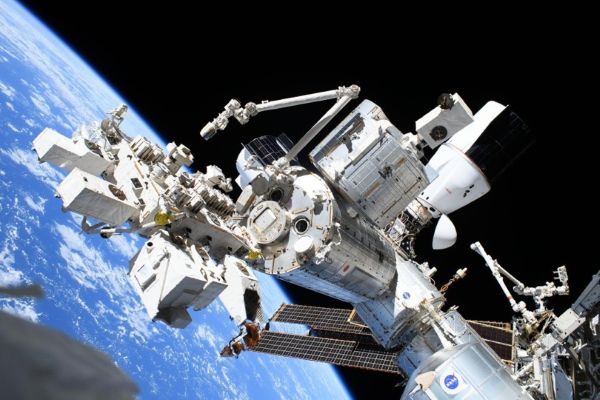
I have written about the end-of-life plans for the International Space Station (ISS) before and about potential replacements. Only this week, NASA finally issued a draft request for proposal (RFP) to industry partners to submit designs with plans for building and operating an ISS successor.
The presence of a permanent Low-Earth Orbiting (LEO) successor to the ISS cannot be underestimated. The ISS has been both a valued environment where humans have tested our ability to adapt to an off-world existence. It has served as a micro-gravity environment of inestimable value. In addition, it has been a global project involving many partnering countries. Where else can Russian cosmonauts and American and other nations’ astronauts break bread together?
Lately, the ISS is showing its age. One of the Russian modules has experienced leaks, with astronauts and cosmonauts seeking shelter in their attached spacecraft until the problem was resolved. The ISS cannot go on indefinitely even though some at NASA and in the U.S. government keep talking about extensions. The planned end date of 2030 or 2031, however, should be adhered to, considering it is a decade longer than the original ISS best-before date.
NASA RFP Solicits an ISS Replacement
An industry briefing today will provide background and answer questions about the new request to industry partners for an ISS replacement. NASA has set July 27, 2026 as a deadline date for industry feedback, with the final RFP to appear near the end of August. The response window is tight: 60 days. NASA expects to award the contract next spring.
NASA cannot help itself when it comes to creating acronyms. The new station is referred to in the RFP as the CLD (Commercial LEO Destination). The RFP draft is looking to have a contractor or contractors cover design, build, operations, crew and cargo parameters and transportation to and from the CLD.
What About Commercial Alternatives Already Here or on the Way?
China’s Tiangong, operational since 2022, will still be in orbit when ISS comes to an end in 2030 or 2031. China’s exclusion from the ISS remains a sore point. That doesn’t preclude future collaborations with Russia’s Roscosmos and other national space programs that are not NASA.
Meanwhile, Russian rumblings have suggested separating its modules from the ISS before the end date and refurbishing and adding new capacity to continue a LEO presence.
American and European commercial partners of NASA are also contemplating replacing the ISS. Several projects are already on the go. These include:
- Vast Space, with the first of its habitable modules, Haven-1, to be in LEO in 2028. Vast plans to deploy up to 9 Haven modules by 2032. The company has been very aggressive recently in its announcements and likely will be the first commercial space station in orbit in the next two years.
- Axiom Space, with its Hab-1, has been partnering with NASA and has built a module it plans to attach to the ISS in 2027. Hab-1 could become free-flying as early as 2028 to compete with Vast.
- An Airbus-Northrop Grumman-Nanoracks partnership has plans to launch a single free-flying habitable module called Starlab. Northrop Grumman originally was building its own space station but joined this project in 2023. Starlab could also launch in 2028.
- A Blue Origin, Sierra Space, Boeing, and Redwire partnership has had plans to deploy a station they call Orbital Reef. Project timelines have slipped, with the likelihood of deployment sometime in the early 2030s.
The Agency is encouraging vendors to engage NASA personnel and expertise as they write their responses.
Three questions:
- Is there capacity in LEO for an ISS successor and four commercial space stations?
- Is NASA expecting one or more of these commercial LEO project developers to respond to this RFP using their existing platforms with modifications?
- Will NASA even need to proceed if one or more of these commercial LEO stations launch before the Agency begins the project?