When we talk about the demand for energy resources, geothermal is the orphan in a family of technologies that include thermal, hydroelectric, solar, wind, nuclear, wave and tidal power. It shouldn’t be.
What is the geothermal energy potential of our planet?
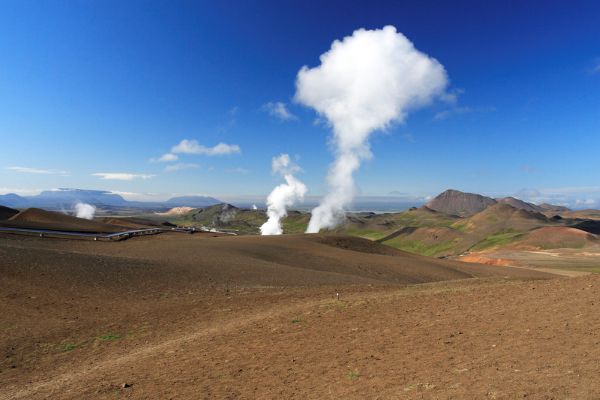
The International Energy Agency estimates that geothermal capacity to power humanity, if exploited, would exceed present energy demand by a factor of 150. That’s right! The energy potential of using heat coming from below ground represents an enormous energy well to exploit to meet global electricity demand.
So why isn’t it in every conversation when we talk about tapping into the energy potential of
Earth?
Why aren’t the fossil fuel companies that explore for oil and natural gas taking the technologies they use for the job and applying them to harvesting the geothermal energy beneath our feet?
Geothermal Today
Global figures show 835 geothermal power plants operating today in 50 countries with 16.6 GW of operating capacity and 14.3 GW of prospective capacity. Three different technologies are currently in use:
- Dry steam geothermal refers to capturing the energy potential from naturally occurring sources of steam. No water is injected. These plants represent a small minority of existing geothermal sites. They are found in areas where volcanic activity is prevalent. These are called dry-steam geothermal power plants. Of the approximately 60 operating dry steam plants, the largest can be found in California, Italy, Indonesia and Japan.
- Flash steam refers to pressurized water being injected into an underground heat source. When the pressure is released as the water surfaces, it produces flash steam. Flash steam plants are the most common ones to be found today (approximately 37%). They can operate when tapping lower-temperature underground heat sources.
- Binary cycle refers to technology that transfers heat from water circulating underground to a second fluid with a lower boiling point to produce steam.
The Latest Geothermal Breakthroughs
A recent Peter Diamandis Metatrends newsletter discussed two leading-edge geothermal companies that he describes as transitional and that may propel this power-generation technology into a mainstream energy resource.
The two companies are Fervo Energy and Quaise.
Fervo
A recent 21-day drilling project reached a depth of 5,928 metres (19,448 feet), and included lateral drilling of 2,286 metres (7,500 feet). Lateral drill fracking extends the search range for substantial underground heat sources with sustainable runtimes. If the tapped heat sources reach 238°C (460°F), well above the boiling point of water, they can be used to generate power. Fervo’s current project is designed to produce 400 MwH of continuous power. The question is: For how long?
Fervo is using fossil-fuel-industry-standard drilling technology to reach deep underground heat reservoirs. The technology involves inserting pipes into these drilled holes and injecting water. The water gets superheated and returns to the surface as steam, where it can power turbines connected to generators. Again, Fervo’s above-ground technology is similar to what gets used to generate power in thermoelectric power stations that are fuelled by coal or natural gas. The big difference is: no carbon emissions. Instead, you have a geothermal energy factory that operates 24/7.
The caveat for Fervo’s approach is this. The drilling method deployed, along with fracking, can negatively impact the heated rock source, reducing the facility’s effectiveness. Maintaining consistent underground temperatures or enthalpy, therefore, is critical. Injecting water can reduce underground rock temperatures faster than natural sources can restore the heat. Drilling and fracking can expose an underground heat zone to a sudden influx of cool water. Thermal drawdowns reduce the running life of geothermal projects.
For Fervo to rise to an industry lead, it must demonstrate consistent results from drilling and fracture operations that produce long-term stability, power production, optimal water management, and limited thermal drawdown.
In his comments about Fervo in Metatrends, Peter states that the company’s model could become a practical power solution for much of the western half of the United States where geothermal capacity appears to be significant.
Quaise
Quaise is a more unconventional choice in the geothermal energy race. In July 2026, it announced two drilling project site successes, reaching depths beyond 5,000 metres (over 16,400 feet). One project is in Texas and another in Oregon. This is a depth well beyond the capability and economic viability of the technology Fervo is deploying.
What is it? MilliMetre-Wave (MMW) drilling is a technology adapted from fusion energy research. It uses high-power radio frequency (RF) transmissions and next-generation magnets to create deep and stable boreholes. Instead of grinding through thousands of metres of dense rock, its high-frequency waves heat and fracture it.
MMW is rated to achieve drilling depths of 15,000 metres (over 49,000 feet). That far below the surface, the potential to harvest heat with limited thermal drawdown expands exponentially. That’s because of the planet’s geothermal gradient, rising 15 to 30°C (27 to 54°F) per kilometre. At 10,000 metres, average temperatures within Earth’s crust reach 250°C (450°F) warmer than at the surface.
Quaise is targeting the deeper potential for reliable geothermal energy production. A recent study indicates that a well of sufficient depth would produce several times the output of a conventional geothermal power site. The unknowns remain because of the great depth of these projects and the reliability of MMW technology to deliver. Can the borehole remain clear to the great depth as rock gets vaporized to ensure a continuous source of geothermal heat?
For Quaise, these are early days. It will be interesting to follow the company’s upcoming borehole tests.
Perfecting Geothermal Power Production
In Metatrends, Peter notes that geothermal power plants need to perfect heat exchange technologies. He notes that drilling to find hot rock doesn’t automatically mean you can produce electricity. He states:
“The reservoir must allow water to contact enough rock surface area, while maintaining flow between injection and production wells. If fractures are too tight, output is low; if they are too open, water may short-circuit through the reservoir and return before absorbing much heat. Excessive stimulation can also increase seismic risk or cause fluid losses.”
A Stanford University study identified the challenges the geothermal industry faces, noting the need for reliable and durable heat exchange technology and durable well construction that produces an infrastructure capable of operating for decades. The study noted that the geothermal loop that injected water into the ground and then carried the heated liquid back to the surface was inherently vulnerable to structural weakening, corrosion, scaling, erosion and stresses from the changing thermal gradient during operations.
So the jury remains out on these two geothermal players. What’s good about the industry, however, is that there are more players to look at. We will do just that in future articles posted to this site. Expect to learn about Sage Geosystems, XGS Energy, Eavor Technologies, Ormat Technologies, Calpine Corporation, Enel Green Power, Kengen, Pertamina Geothermal Energy, Star Energy Geothermal, Zorlu Enerji and more.
Don’t blink in this century because you may miss the technology express train hurtling us toward 2100. Geothermal advances will be on that train as global energy demand escalates as we look for new ways to meet future expectations.