
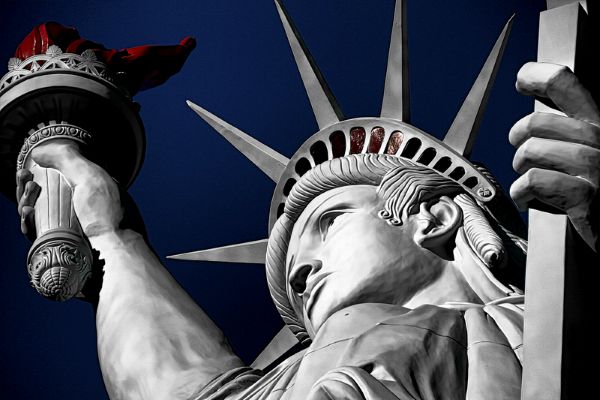
Something most of us would never have predicted just ten years ago was that the United States would succumb to vacuous leadership and plunge the world into increasing uncertainty. How America has veered off track and descended the rabbit hole under the “reign” of Donald Trump demonstrates that the Reagan Shining City on a Hill has lost its spark.
Indeed, Trump’s ascendancy is regal, not presidential. The division of powers enshrined in the U.S. Constitution is not working. The result, America is ruled by King Trump, the successor to George III, a monarch that Americans chose to overthrow in 1776.
The impacts are far more than political. Trump’s executive decisions have been detrimental to fighting the causes of climate change. The health of the U.S. and the rest of the world has been put at risk. Cutting off U.S. Aid has worsened global food security and aided disease outbreaks in the Global South. His war pursuits have disrupted global supply chains. His court jester cabinet and appointees are making a mockery of the law.
Trump’s administration is anti-science and anti-knowledge. This is after more than 80 years when the United States led the democratic world, attracting the best scientists, built the most innovative technologies, and sparked the Green Revolution to reduce global food insecurity and disease. US largesse raised all boats as a Pax Americana ensured a more peaceful world even in the face of a Cold War with the Soviet Union. When the Berlin Wall fell, some historians proclaimed the end of history and the triumph of liberal democracy over communism and fascism. These were heady times despite blips like the Vietnam War and America’s internal racial strife.
America turned swords into ploughshares, taking a military communications technology and turning it into the Internet. Instant global telecommunications became the new reality, which further allowed America to share its intellectual capital with the world.
America and Environmental Challenges Yesterday and Today
Richard Nixon created the Environmental Protection Agency (EPA). American scientists gave us our understanding of the environmental challenges our industrial society was creating. They developed insights into pollution and atmospheric chemistry, ecosystem and biodiversity loss, and the growing threat of climate change.
The EPA and the National Oceanic and Atmospheric Administration (NOAA) monitored Earth systems using American-built satellites and a network of Earth-based monitors (air, land and water). Their research led to the undisputed scientific conclusion that human activities on Earth were causing greenhouse gas emissions to rise and global warming. Americans collected data and supplemented brilliant science minds and researchers.
Under Trump, through budget reductions and staff firings, today’s EPA and NOAA are hollowed out. Their research-produced environmental standards are no longer being followed. Deregulation has given the industrial polluters a free hand.
America, Global Health and Food Security Yesterday and Today
The United States, post-World War II, became a leader in contributing to health and food security around the world. It operated through programs set up by the federal government: US AID, the Centers for Disease Control (CDC), the National Institutes of Health (NIH), and others.
U.S. programs promoted vaccines, provided maternal and child health and nutrition, supported family planning, research on diseases, health worker training and more. This wasn’t exclusive to when the Democratic Party was in the White House. Republican administrations were equally involved.
The programs combined money, knowledge, data systems, infrastructure, research and partnerships within countries around the world. American support for food security included supplying emergency food during drought and famine, food to counter malnutrition, help in improving local agricultural productivity, and rural financial assistance.
Since the beginning of 2025 under Trump’s second term, foreign aid has been paused. US AID is dismantled. Global health programs to fight HIV, malaria, tuberculosis and Ebola have been decimated. The current Ebola outbreak in Africa has been impacted.
America’s federal international crisis response has been severely weakened by significant funding cuts. American aid is tied to Trump’s America First agenda and national security priorities.
The loss of continuity in funding to support international health and food security programs has been consequential. America’s soft power credentials are in question.
America, International Trade Yesterday and Today
The U.S. has always championed lowering barriers in trade to allow American companies access to global market opportunities. From its days as the Arsenal of Democracy in World War II, to the post-war Marshall Plan, to the championing of the World Trade Organization (WTO), the U.S. has always led.
America promoted open markets, WTO rules and regulations, shared trade rules, the North American Free Trade Agreement (NAFTA), bringing Mexico, Canada and the U.S. together to create a continent-wide free trade zone. Since Trump’s first term, when he replaced NAFTA with the U.S.-Mexico-Canada Agreement (USMCA), free trade has been under threat.
Trump sees international trade as a win-lose contest. A trade surplus means you win. A trade deficit means you lose. What gets counted and what does not determines winners and losers.
Trump’s Liberation Day announcement last year established arbitrary tariffs on countries that sell and buy from America. This managed trade strategy through the application of tariffs, without congressional oversight, is a departure from how America conducted business with the rest of the world. Everything is bargaining. Everything is transactional. Tariffs no longer follow the WTO guardrails. Signed agreements like the USMCA no longer hold weight.
In the last two days, Canada and the United States have entered a trade war. The two countries in 2025 participated in two-way trade in goods and services totalling CDN$1.287 trillion. The two countries have integrated industries with finished products often going through assembly processes that go back and forth across the international border. It is the world’s largest bilateral trade arrangement and Trump’s managed trade strategy and brinksmanship has brought it to crisis? This is a test case for any other country negotiating under Trump’s managed trade strategy.
America, Global Politics Yesterday and Today
Once the global leader in the world, its most powerful political actor, often establishing unilateral positions that led to military blunders like Vietnam and Iraq, the U.S. can no longer assume that allies will follow its lead.
By the end of World War II, America was the sole superpower. It was soon joined by the Soviet Union. These were the first two nuclear-armed nations. Post-war Europe came under the U.S. defence shield through NATO. Canada and the U.S. created NORAD for North American defence.
The Soviet Union fell in 1991. For a little more than a decade, no other nation challenged America’s hegemony. China’s rapid rise in the first two decades of the 21st century has changed the balance of power. As Russia succeeded the Soviet Union, it remains a nuclear-weapons threat. Its war in Ukraine has consumed it for the last four-plus years with little success. That doesn’t lessen Russia as a dangerous global player.
Meanwhile, regional wars are ongoing as new ones emerge. The great power competition and might-makes-right diplomacy are making for a less safe future.
The alliances of the past are less automatic. Economic interdependencies are being weaponized (see the Canada-U.S. trade dispute). U.S. leadership approval among allies has fallen dramatically while more positive perceptions of America’s chief rival, China, are on the rise.
Global confidence in Trump’s America is on a rapid decline, reflecting the administration’s attitudes toward alliance members (Denmark and Greenland), Canadian trade and 51st state threats, restrictive immigration policies and deportations, climate policy, and military interventions like the current Israel-Iran-U.S.-Persian Gulf nations’ conflict.