
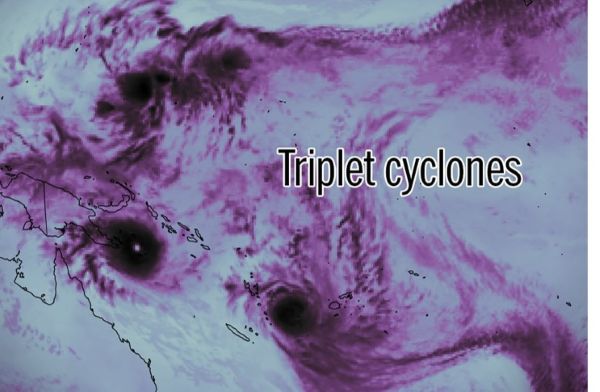
With the ending of the latest La Niña, the U.S. National Oceanic and Atmospheric Administration (NOAA) is reporting a triplet of cyclonic storms straddling the equator in the Northwest Pacific Ocean this week, posing a threat to the Federated States of Micronesia, the Solomon Islands, Guam, Northern Mariana Islands, and Papua New Guinea.
This is happening as the next El Niño is predicted to emerge by June. It is not the first time twin or triplet storms have formed, but they usually occur after an El Niño event.
What does it mean for the Pacific islands in the path of any one of these storms? Heavy rains, extreme heat, flooding, landslides, storm surges, and high winds, in other words, not good times ahead for these island nations.
Scientists at NOAA state that atypical convection currents and wind patterns over the equatorial Pacific cause cyclonic storms to form. With no large landfalls to dissipate the accumulating energy and moisture, the swirling winds develop a classic hurricane signature with a central low-pressure eye as seen in the storm on the lower left in the image above. This storm lies to the east of Papua New Guinea and north of Queensland, Australia. Weather models indicate the three storms could slow down, becoming nearly stationary over the next week. What that will do is create an enormous hot spot in the Western Pacific with rainfall levels between 127 and 254 centimetres (50 to 100 inches). Papua New Guinea is forecasting flash floods and landslides.
The El Niño Cometh
These triplet storms occurring at the beginning of April are a significant sign, with climate scientists stating that their arrival indicates that the planet continues to run a fever and that the rate is accelerating.
This will feed an early occurrence of the next El Niño, creating a hot spot that will push warm water from the Western Pacific to the coast of South America, forming an enormous feedback loop which will cause more thunderstorms and stronger westerly winds.
The Super El Niño Cometh
States Zele Hausfather, the chief scientist at C3.ai, cofounder and chief scientist of Efficiency 2.0, a Breakthrough Senior Fellow and research scientist at Berkeley Earth, told The Washington Post, that the arrival of the El Niño will “push up our estimate for 2026 global temperatures, and make 2027 very likely to be the warmest year on record.”
NOAA is predicting a super El Niño in 2026 through 2027. James Hansen’s climate models support NOAA’s prediction. Hansen, the man who is most associated with breaking the story about anthropogenic climate change, believes this El Niño will be the strongest on record, affecting global weather patterns. It will be a super El Niño. They typically occur once every 10 to 15 years, but now, the rate of recurrence is faster with climate conditions persisting much longer and ranging much further.
What does a super El Niño mean for conditions in the tropical Atlantic? Fewer hurricanes in 2026, into 2027. Fewer hurricanes, however, don’t equate with less powerful ones. Previous low hurricane years have produced some of the strongest on record.
U.S. Defense Department meteorologist Eric Webb, whose handle is @webberweather, describes the increased frequency in El Niño cycles as follows:
“The climate system cannot effectively exhaust the heat released in a major El Niño event before the next El Niño comes along and pushes the baseline upward again.”
Why can’t the climate system get rid of the heat? Human-created carbon and other greenhouse gas (GHG) emissions are the pump feeding modern climate change. This isn’t Mother Nature variability. This is us, and the faster we turn down the flow of our GHG pump, the sooner we can slow down the change we are creating.