
The following is not a posting about technological innovation and scientific discovery. Instead, I am reverting to the historian in me as I watch the latest Middle East war accomplish little in terms of creating peace.
This March, I read lots of articles on the history of the Middle East, trying to explain Iran, the Arab nations, Israel and the United States strategic interest in the region. The word drama defines what has been happening over the last month. This drama has also involved people dying, many civilian bystanders to the conflict. A war to decapitate the leadership of a country that has recently seen massive protests on its streets, and that has been aspiring to build nuclear weapons, has been targeted.
All this has happened during the Muslim holy month of Ramadan, and a few weeks before Easter and Passover. It doesn’t matter whether you are a Jew, Muslim or Christian; the events we are witnessing are sobering and having a deleterious effect on more than those living in the Middle East.
I know you are used to me writing about science, technology and the future, but the geography and history I studied in university focused on the Middle East. It remains an area I continue to research and study to this day.
So many voices have weighed in on the current war. That’s why I thought a historical context might be of value.
The Checkered History of Iran, Israel and America
Those who practice any of the three monotheistic faiths originating from the Middle East see the history of its conflicts through different-coloured lenses. What many may not know is that these three current antagonists, Iran, Israel and America, were once steadfast allies.
How so?
Iran was always coveted for its oil fields. That’s what drew America and Britain to it in the 19th and 20th centuries. In 1953, however, America and Britain became alarmed when the Iranians democratically elected a government that was deemed anti-Western and a threat to their economic interests. In a coup, the two overthrew the government to reinstate the monarchy under Shah Mohammed Reza Pahlavi. For this, the Shah granted expanded oil concessions. The 1979 Islamic Revolution ended the Shah’s reign and America’s presence in the country, with the U.S. embassy staff held hostage. Iran called America the “Great Satan.”
The story for Israel and Iran was different. Both shared common Arab neighbouring enemies. Why Iran saw its Arab neighbours as enemies is explained in the next section of this essay. Nevertheless, Iran was among the first nations to recognize Israel in 1950 against the protests of its Arab neighbours. Iran also supplied Israel with oil. It supported Israel during the wars in 1967 and 1973. Israel supplied technical and military assistance and expertise, as well as security intelligence, to the Shah’s government. With the 1979 revolution, Iran’s rulers declared Israel the “Little Satan.”
Sunni, Shia, Arab and Persian
So, why are neighbouring Arab countries Iran’s enemies? The story begins at the very beginning of Islam in the 7th century CE. When Muhammad died, two competing groups claimed leadership of the “umma,” the community of believers. One of the leaders was chosen from early followers of Muhammad by the general Muslim community, or “Sunna.” Sunni Islam comes from the word sunna.
The second competing group wanted the leadership to devolve to Muhammad’s descendants. There was no direct male heir, but rather Muhammad’s son-in-law and cousin, Ali. Shia Islam got its name from “Shiat Ali,” the followers of Ali who chose him to lead the Muslim community.
For a while, there was peaceful coexistence between the rival claimants. Eventually, however, the dispute turned violent with Ali’s son, Husayn, killed and martyred in battle in 680 CE at Karbala in what is modern-day Iraq. The Shia faith symbolically began with that martyrdom.
Currently, nearly 90% of Muslims are Sunni. In Iran, nearly 95% of Muslims are Shia. As Shia, Iran’s Muslim identity reinforces the country’s perception as unique within Islam. The Iranians are direct descendants of the Persian Empire and dynasties that existed a thousand years before Muhammad.
With the Islamic Revolution in 1979, Iran, under the banner of the Shia faith, has championed a revolutionary version of Islam elsewhere. Iran has doubled down on its position on Israel, backing Palestinian resistance groups. Shia Iran has established military proxies to combat Israel and its Arab Sunni neighbours. It fought a 10-year war with a Sunni-led Iraq. Its proxies include:
- Hezbollah, a Shia Islamist organization, is a state within the state of Lebanon and champions a Palestinian state where Israel currently exists.
- Hamas, in Gaza, is a Sunni Islamist resistance organization with which it is allied, with a focus on ending Israel’s existence.
- The Houthis, in Yemen, are a Zaydi Shia sect, in war with Saudi Arabia and warring from a distance with Israel. The Houthis have laid siege to the straits that link the Arabian Gulf to the Red Sea, a chokepoint that we will look at in the next section of this posting.
Geography, Economics, Oil and the Current War
When Israel and America launched an aerial and naval war on Iran on February 28, 2026, likely both saw this as a short, sharp conflict to assist an Iranian native uprising to overthrow the Islamic Republic. Precision strikes targeted the leaders of the government with a degree of success. Decapitating those in control was seen as a quick way to produce regime change. What didn’t happen, however, was the collapse of the state. So what were Israel and America going to do next? How would the very much alive Islamic Republic respond to the aggression?
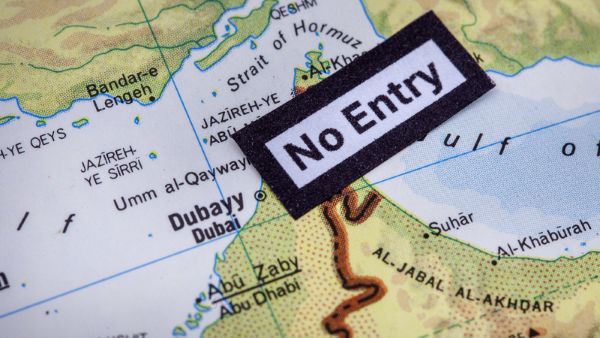
Geography and economics provide the answer. Iran overlooks the Persian Gulf and the Strait of Hormuz, the outlet to the Arabian Sea. Through the Gulf flows oil, gas, fertilizer, helium, pharmaceutical precursors and more. If Iran could threaten to close the Strait, the country would create an economic chokepoint. That’s exactly what Iran has done. At the same time, the Houthis, who have been firing missiles and launching drones and shipping going through the Strait of Bab-el-Mandeb at the mouth of the Red Sea, upped their game.
Two straits, two chokepoints. Oil prices have skyrocketed. Natural gas exports are blocked. With just a few drones and missiles, Iran has stymied the more powerful militaries of its two enemies. Short of sending in troops and seizing control of the two straits, Iran and its Houthis proxy can maintain control of these chokepoints indefinitely.
What’s incredible to me is that a study of the region’s history would clearly have shown the weakness in America’s and Israel’s war strategy. The two straits have been chokepoints, fought over for centuries, going back to the Roman and Persian Empires. The Portuguese in the early 16th century fortified the Straits of Hormuz to protect their trade monopoly in the Indian Ocean. Great Britain’s navies controlled the two straits in the two world wars. With the lessons of history ignored, what will likely be the outcome?