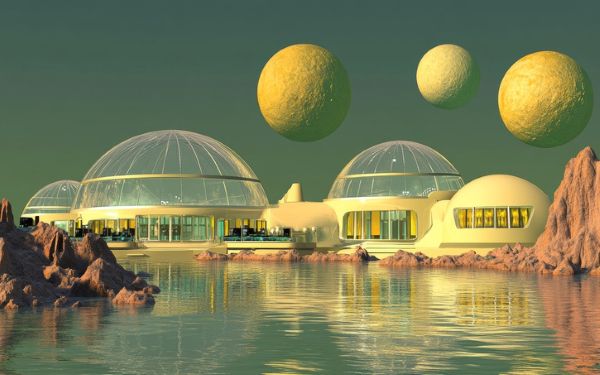
The title of this posting asks the question “What holds our future back?” You may propose answers like the limit to our imaginations, fear of change, and more, but, in truth, what truly holds us back is the finite physical and resource limits of Planet Earth. Yet, just 250 kilometres above the planet begins the infinite expanse and resources of outer space.
Voyager 1’s Journey Lends Perspective
Yesterday, I read that Voyager 1, launched on September 5, 1977, and beginning a tour of the Gas Giant outer planets of the Solar System, had reached a light-day from Earth. A light-day represents a distance of 25.9 billion kilometres (16.1 billion miles).
The Voyager 1 mission took 2 years to reach Jupiter and an additional year to get to Saturn. Since then, it has become the most far-reaching ambassador of Planet Earth and human civilization ever sent into outer space.
Tens of thousands of years from now, Voyager 1 will approach one of the stars in the Little Dipper constellation (Ursa Minor). If it had been heading to our closest neighbour, Proxima Centauri, the voyage would require an additional 1,547.6 light-days (4.24 light-years) and take 77,380 Earth years.
As Voyager 1 passed the Heliopause that marks the furthest reach of the Sun’s influence, it has been encountering interstellar space, and it’s not empty. Even in this near vacuum beyond the Solar System, there are atomic particles and whole atoms, plasma, magnetic fields, and gas pockets. Our previous perceptions of space being a vacuum have been proven wrong. Even when there are no stars, planets, moons, asteroids and comets, there is lots of space stuff which we humans may use once we get that far.
Harvesting Humanity’s Next Giant Leap
The above mathematics illustrates why planet-bound thinking cannot prevail for humanity. We already know of evidence that biological precursors for life exist on Mars and asteroids. That points to life elsewhere, and even intelligent life. How small is our thinking when we see ourselves planet-bound forever?
Our corner of The Universe has plenty of resources to go around. In our Solar System alone, we can harvest the energy and materials to build hundreds of Earths. That’s because space provides us with near-infinite quantities of everything humanity needs: lots of real estate and the energy of the Sun to light and power it are just a beginning. Add all the extractable materials we can harvest, beginning with the Moon and asteroids, and humanity can be off to the interplanetary races.
The Promise of the Moon
Elon Musk covets a real estate empire on Mars with a city of a million in the latter part of this century. Is this fanciful thinking? Maybe not if we begin with lunar real estate.
I receive newsletters and meeting notes from NASA’s LSIC group, which meets monthly to coordinate ISRU, an acronym that stands for In-Situ Resource Utilization for future space travel. LSIC scientists and engineers are designing the essential engineering that NASA will deploy to exploit local lunar and Martian resources on planned and future missions. The benefits of the ISRU strategy include:
- Less material needed on launches from Earth.
- Fewer launches and lower costs as a result.
- Significant human risk reductions and greater mission flexibility.
The Moon’s surface can provide propellants (hydrogen) and life support consumables (water and oxygen). Lunar regolith can be source material for surface infrastructure. Lunar regolith can shield habitations from cosmic and solar rays.
With permanent human presence, we can begin harvesting significant amounts of Helium-3 (He-3), a non-radioactive isotope of Helium found in-situ. Today, He-3 is highly regulated on Earth because it is not naturally occurring here. It is a byproduct of radioactive decay from tritium, which is used in commercial nuclear reactors and bombs. He-3 is worth between US$15 and $19,000 per gram. Current Earth uses include neutron scattering applications in fields like materials science, physics and chemistry. He-3 is used in quantum computing, medical imaging, cryogenics, soil and gas exploration, and phase-transition research on polymers and superconductors.
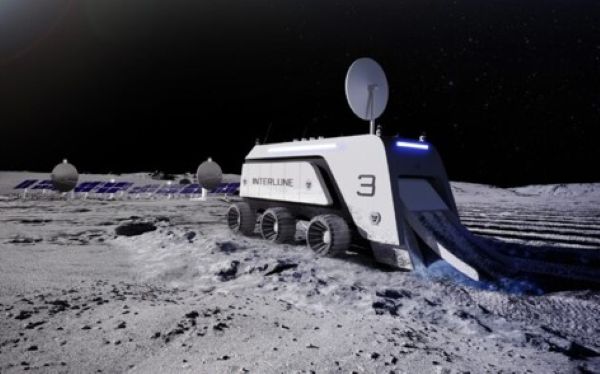
The promise of commercial nuclear fusion is premised on adequate supplies of He-3. A Gigawatt fusion reactor needs approximately 52.5 kilograms of He-3 per year. He-3 in the first metre of the Moon’s surface is estimated to total 220,000 metric tons. Lunar robotic miners are already under development for extracting He-3 and other high-value materials from the Moon’s surface.
The Promise of the Asteroids
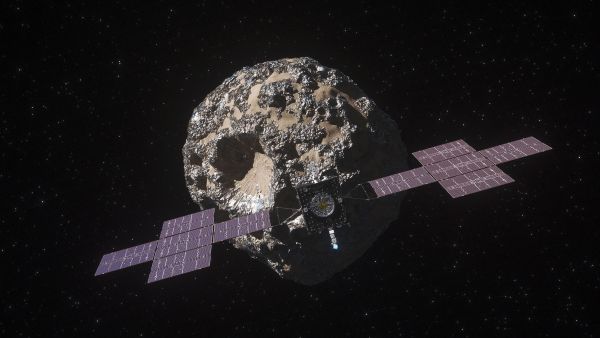
In 2023, NASA launched a mission to the asteroid Psyche (see image above). The spacecraft, also named Psyche, will arrive in 2029 to study its properties.
Psyche lies between Mars and Jupiter. It is thought to be a planetesimal core remnant, part of the metallic centre of a planet that never fully formed during the early history of the Solar System. From Earth observations, we know that Psyche is rich in metals, between 30% and 60% by volume. It likely contains more nickel than has ever been mined on Earth. It also contains iron and other metals, as well as silicates.
An estimate of Psyche’s mineral wealth has produced the following: US$10 quintillion, or $10,000,000,000,000,000,000. That’s greater than all the mineral wealth we have extracted to date or will in the future from Earth.
Psyche, by Voyager 1 distance standards, lies right next door to us here on Earth.
Then there are carbonaceous asteroids, containing water (hydrogen and oxygen), hydrated minerals, carbon, other organics and chemicals, and bulk construction and shielding materials.
Recent sample return missions to Bennu and Ryugu, two carbonaceous asteroids, confirmed the presence of fuels and life support resources, other valuable organics and bulk materials for constructing space infrastructure.
The Moon and Asteroids Are Just the Start
Beyond the Moon and before the Asteroid Belt lies Mars. Elon Musk’s forever ambition, it seems, is to make humanity an interplanetary species by colonizing Mars. This would avoid an Earth extinction-level event like the one that ended the dinosaurs.
Colonizing Mars, however, is not necessarily a good fit when considering an infinite resource acquisition strategy. The Moon and asteroids are better, even though Mars could implement an in-situ resources strategy to build local infrastructure. But Mars is harder to get to, has more gravity than either the Moon or asteroids, and is less attractive for establishing a large-scale space economy. The Moon and asteroids can do that. What Mars can be is a good watering hole (it’s got lots of ice), and a potential proving ground for human multi-planetary space ambitions beyond the Solar System.
Beyond Near Physical Space
Elon has talked about harvesting the infinite resources of space. So has Peter Diamandis of XPrize fame. Joining them are people like Jeff Bezos of Amazon and Blue Origin. All of them see humanity’s future in space, where near-infinite quantities of everything we need are available: energy, materials, real estate, and more.
- Unlimited sunlight beyond low-Earth orbit to power everything.
- Material resources from the Moon and asteroids to build a space manufacturing belt around Earth while allowing the planet to return to green.
- Unlimited personal connectivity and ubiquitous access to the Internet and the sum of all human knowledge.
- AI superintelligence from space delivered from an orbiting constellation of satellite data centres.
Can SciFi Become SciReality?
“The Expanse” was a science fiction television series that ran through the COVID-19 pandemic years. I watched it as I recovered from both the virus and knee replacement surgery.
The series was set several hundred years in the future. Humans had colonized much of the Solar System. Mars was independent. Colonies existed on the Moons of Jupiter and Saturn, and Ceres in the Asteroid Belt had become the capital of a new independent nation.
Other than the plot and story lines, is “The Expanse” depiction of humanity’s future more plausible than Star Trek? I think so.
Our Current and Near Future Reality
Why can the future look something like “The Expanse?”
Earth, today, has more than 14,000 artificial satellites circling it and thousands more planned for launch. The Moon has a growing inventory, as does Mars.
The NASA Artemis Program and China’s Space Agency are both racing to build a permanent base on the Moon. That will mean more space infrastructure in proximity or orbit around the Moon. If Artemis timelines are kept, a permanent surface lunar presence will begin before 2030. Lunar mining and factories will begin to churn out the materials needed to support space infrastructure beyond the Moon.
Big Tech has entered space to make money. SpaceX recently launched a public offering that turned the company into a multi-trillion-dollar play. Blue Origin, RocketLab and others will likely follow the same path.
Will we see space stations turn into permanent space communities? Will asteroid mining be the business opportunity to justify asteroid mining towns?
Fuel depots like today’s service stations here on Earth will string across interplanetary highways in Solar System space, providing convenient waystations for voyages to Mars, space communities and the Asteroid Belt.
In the making, new propulsion technologies will speed up space travel and shorten the timelines between Earth and lunar space, Mars, the Asteroid Belt and real estate on the Moons of Jupiter and Saturn.
Voyager 1 will still have us beat unless the Warp drives of Star Trek become real. We will, however, no longer be bound by our finite planet and will tap into the infinite and limitless resources to power and sustain humanity beyond the 21st century.