
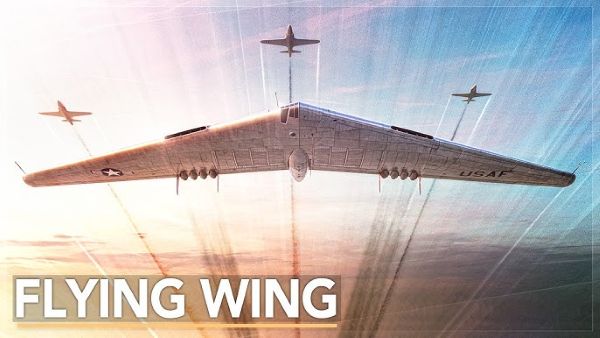
The picture heading up this posting is of an imaginary airframe, a flying wing. Often featured as futuristic aircraft, flying wings have appeared in science fiction movies like the 1953 version of War of the Worlds, Raiders of the Lost Ark, and Dune.
Today’s commercial aircraft use a tube-and-wing body (TWB) design. It remains the industry standard. In terms of design, the only recent innovation has been winglets to increase fuel economy. By the late 2030s, however, TWB may see a new challenger featuring a blended-wing body (BWB).
BWB as a design concept for aircraft was first patented in 1876.
The first working BWB prototype, however, didn’t appear until 1940. That’s when Northrop, a U.S. airframe manufacturer and now Northrop-Grumman, launched the N-1M (see image below) during the early days of World War II.
Today, N-1M’s BWB successors include two Northrop-Grumman aircraft, the B-2 Spirit (truly a flying wing) and the B-21 Raider. Both are stealth bombers deployed by the United States Air Force (USAF).
Why are BWB designs of interest to the military? They provide aerodynamic surfaces with less drag. The aircraft’s design and the materials used minimize its radar signature.
BWB Aircraft Interest Commercial Operators
BWB designs provide two distinct advantages over current TWB designs.
- BWB is more fuel efficient. Consider fuel represents the largest percentage of operational costs for airlines at 28%, according to the International Air Transport Association (IATA). In addition, with the politicization of jet fuel supply, recently demonstrated with the Strait of Hormuz chokepoint, airlines are looking for new answers, and BWB is near the top of the list.
- BWB offers greater payload and passenger capacity because the blended shape expands cabin and cargo designs and distributes payload across the airframe more efficiently. More passengers and cargo means more revenue.
Those two compelling arguments alone are making airlines look at BWB aircraft for future operations.
BWB Industry Inhibitors
The shape of BWB aircraft poses problems for existing airport infrastructure, built to accommodate TWB designs. Conventional TWB layouts are well understood by airline operators. Airport systems have been TWB-designed for handling passengers and cargo.
BWB designs will require redesigning some features of airport buildings, tarmac approaches to gates, jetways that can offload and onload passengers smoothly, baggage and cargo systems, and passenger safety operations.
For tech nerds, BWB wins hands down. In terms of practicality, however, TWB will be hard to dislodge as the prime means by which airlines move passengers for the foreseeable future.
Past, Current and Future BWB Players
There are several companies and NASA working on BWB designs. Here are some of the players who were in, or are in the race to deliver a BWB aircraft for passenger and cargo.
Airbus developed a BWB based on a proof-of-concept named MAVERIC (not to be confused with Tom Cruise’s movie moniker). MAVERIC is a 2 metres by 3.2 metres-sized model. The acronym means Model Aircraft for Validation, Experimentation, and Robust Innovative Controls. Flight testing began in 2019. The flight tests ended in mid-2020. No announcements about a full-scale version are in the works.
JetZero is a California-based company that is working on Z-5, a full-sized BWB aircraft. Scaled BWB demonstrators, called Pathfinder, have successfully flown. Jet1Demonstrator, a full-scale Z-5, is scheduled for delivery to the USAF in 2027. The USAF has invested $235 million in the project along with other investors that include Germany’s military, Alaska Airlines, and EasyJet. JetZero’s build partners include Scaled Composites, Northrop-Grumman and Pratt & Whitney. JetZero has targeted the early 2030s for Z-5 to enter commercial passenger and freight service.
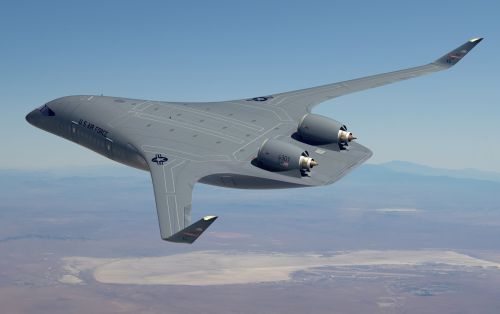
NASA – Boeing developed the X-48 program beginning in 2000. A model version called the X-48B was developed between 2002 and 2007, with the latter date. An X-48C last flew in 2013. There is no indication that NASA or Boeing intend to continue working on BWB demonstrators or a commercial product.
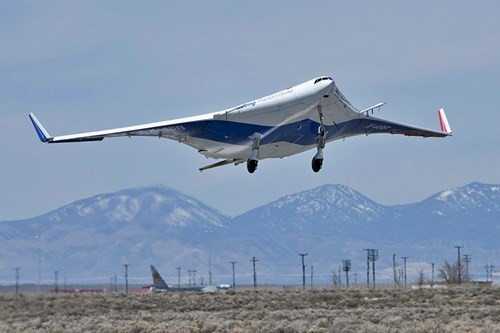
Natilus is a 2016 California startup. It is developing two BWB aircraft models: Kona for cargo and Horizon EVO for passengers. Kona will carry a 3.8-ton payload over short flights up to 1,600 kilometres (900 nautical miles). Horizon EVO will carry up to 200 passengers. Expect a working full-scale prototype to fly by 2028. Horizon EVO, aimed at the Boeing 737 and Airbus A321 Neo market, will follow. The goal is to enter commercial service with both by the early 2030s.
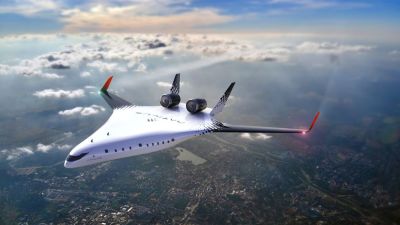
NPU/AVIC/COMAC – A group of Chinese institutions and companies are working on BWB aircraft. The Northwestern Polytechnical University (NPU) and the Commercial Aircraft Corporation of China (COMAC) are researching and designing scaled models as prototypes for a future commercial aircraft capable of transporting more than 300 passengers. China has yet to acknowledge past or future flights.


 design. By the 2030s, new aircraft designs will include blended-wing body (BWB).)