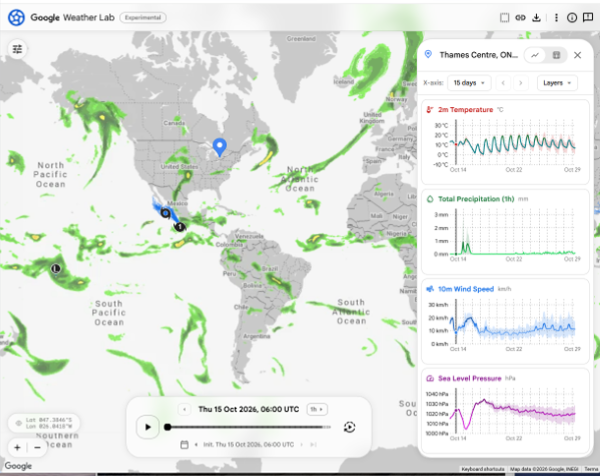
A few months ago I read that Google had launched an artificial intelligence (AI) weather forecasting app. I thought, good for them. Finally, a consequential use for AI that won’t kill us.
Full disclosure, I am a bit of a weather nerd. I consult my barometer daily to see whether the air pressure is rising or falling. I like to study clouds. Our apartment looks over Lake Ontario (that’s right, not Lake America) and Bronte Harbour with a creek bearing that name. The view lets me see weather systems as they approach from the southwest, a common storm track. The city of Hamilton is to the southwest. We see the rain forming over it and watch storms traverse the lake before hitting us. When low-pressure systems approach from the southeast, they bring driving rain and send waves over the harbour breakwater.
So by now you should guess that I’m pretty good at predicting a change in the weather. But with all that folk knowledge, I still look at the forecast in the newspaper (yes, I still get print newspapers delivered to our apartment daily) before I go out. As well, I look at my smartphone weather app to determine if the newspaper, app, clouds, and other visible conditions align.
You would think that Google’s Research and DeepMind can’t add much to this abundance of weather knowledge. But then you are not the weather nerd I am, nor akin to the nerds at Google.
Introducing WeatherNext 3
WeatherNext 3 (WN3) is described as a probabilistic forecasting tool that generates hourly forecasts “moving beyond traditional analysis variables by learning to predict satellite-derived precipitation estimates, as well as tropical cyclone and station observations.” The app uses DeepMind’s AI to create weather forecasting performance for global weather predictions.
Traditional global weather models churn out forecasts every 6 hours. WN3 issues forecasts hourly. The following schematic shows how WN3 ingests sources of input, including recent hourly geostationary satellite images and a number of surface variables which it visualizes. These include: temperature and moisture at 5-kilometre resolution, other surface variables at 10 kilometres, and wind speed and other phenomena at 25 kilometres.
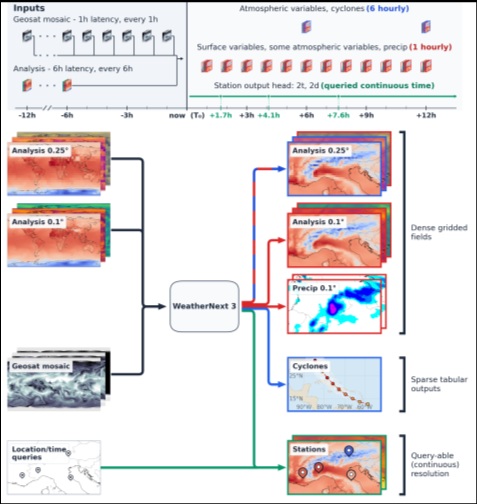
WN3 has been trained on data from complex numerical weather prediction models and supercomputer simulations. It combines the real-time global geostationary satellite data with what it has learned to generate its hourly forecasts for areas with up to a 5-kilometre resolution. At this level of detail, WN3 can predict rapidly developing weather events, a significant improvement over other weather prediction tools that cannot provide this level of detail while recognizing the variables caused by topographic features such as mountains, coastlines, valleys, forests, cities and more.
The result is a significant leap for timely 5-kilometre square global forecasting, something previously impossible to do.
Google’s DeepMind Tackles Hurricane Forecasting
An August 6, 2026 paper published in the journal Nature describes how another AI WeatherNext product called WeatherNext-C (WN-C), the C standing for Cyclones, is capable of generating weather and cyclone scenarios extending 15 days into the future. In the article, it notes that WN-C provides a lead-time advantage of 1 day over current weather modelling tools.
In an article appearing in the New York Times, Amy McGovern, Professor of Meteorology, University of Oklahoma, and Director of the A.I. Weather Institute, states:
“It’s a big deal. If you can tell people a day in advance about a major hurricane, they’ll have more time to evacuate and prepare, in theory saving lives and property.”
In October of 2025, WN-C provided forecasts for Hurricane Melissa, which struck Jamaica. A powerful hurricane with almost 300 kilometres per hour (185 miles per hour), Melissa’s path was anything but straight.
The AI predicted Melissa’s landfall and the pace of its strengthening from Category 1 to a Category 5 storm. Getting people out of the path meant 45 deaths rather than the hundreds to thousands that commonly occur from Caribbean hurricanes. The hourly lead times made all the difference in the world, allowing for evacuations of hospitals and homes on the hurricane’s path.
So, congratulations to Google’s DeepMind nerds for creating an AI application that saves lives rather than one capable of destroying us all.