
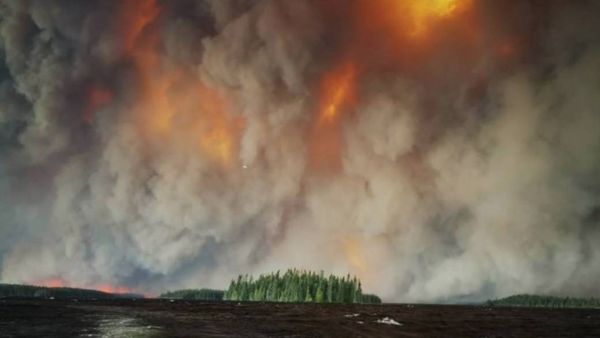
Welcome to the next wildfire crisis, just one of many that appear to be more frequent across North America these days. Of course, those who believe human activity plays no part in this, or that climate change is not real, will deny the increase in frequency, or the link to climate science.
Their denial is at our collective peril.
Among the worst are those in power south of the 49th parallel. Their self-serving, climate-change-denying behaviours are motivated by greed. From the President on down to Members of Cabinet, Congress, and industry-leading billionaires, these American leaders appear to be unwilling to read much beyond financial statements and tea leaves.
Among the ignored signs are:
- Rising temperatures and prolonged heat domes leading to population death rates above normal.
- Increasing extreme weather events including monsoonal rains and flash floods, more intense thunderstorms, tornadoes and hurricanes, and droughts leading to record-shattering remediation and rebuilding costs.
- Rising sea levels that wash away coastal homes and infrastructure and make many American homeowners uninsurable.
- Vector-borne diseases moving northward with cases of illness more than doubling from 2001 to the present.
- More wildfire impacts with longer fire seasons, greater severity and destruction, and extensive wood smoke pollution spreading to areas well away from the outbreaks.
Wildfire Incidents On The Rise
For those American members of Congress who this week sent a strong reprimand letter to Canada’s Prime Minister about the latest wildfire outbreak, you would think the reality of wood smoke from Northwestern Ontario drifting into their states would open their eyes. They demand action from Canada to stop lightning-generated forest fires happening in remote parts of the country. What they should demand is that the U.S. administration begin to take action on the underlying cause, anthropogenic climate change.
The wildfire smoke that is affecting Eastern U.S. states as far south as Virginia is equally impacting Eastern Canada. Forecasts of sunny days have turned dark. My wife and I live in an apartment in Oakville, Ontario, just west of Toronto. Today, our air quality health index is 10, on the edge of very high risk. That number equates to as much as 424 particulate matter parts per million (ppm) in the atmosphere. Where 50 to 300 ppm is considered an acceptable range, 424 is clearly not.
The air outside appears as a dense yellow-to-orange fog. You turn on lights at midday to read. When you can see the air you breathe, it is disconcerting to say the least. It is even more alarming when your mouth takes on the taste of cigarette smoke.
Yesterday, my neighbour’s little boy came into the hall and exclaimed, “The air smells.” It certainly does. Even with the HVAC running, you cannot escape the smell of wood smoke. By our windows and front door, you swear people are smoking strong-smelling Gauloise or Gitane cigarettes.
Worse than the smell and the darkness is the heightened risk wildfire-generated particulate matter suspended in the air brings.
Particulate Matter and Human Health
If you live in or near cities, particulate matter in the air is no stranger. Sources for it include construction and demolition sites, roads and rubber tires, tailpipe emissions and smokestacks. Then there is wildfire smoke, which can travel a long way from its source.
The particulate matter wildfires bring gets inhaled. Particles can be 30 times smaller than a single human hair, or visible to the naked eye like dust and soot. The smallest of these is the most dangerous. These can penetrate the lungs and transfer into the bloodstream and even the brain.
A Canadian Press article appearing on July 17, 2026, quotes Bhavini Gohel, a physician at the University of Calgary’s O’Brien Institute for Public Health. Gohel talks about the dangers of particular matter, noting:
“Before we were very focused on the lungs, but now we’re starting to understand more and more the effects that we’re seeing on the actual brain, and it really is sort of mainly cognitive.”
A May-published study of 7,000 middle-aged Canadians has found that people living in areas with higher levels of air pollution score worse on memory tests. Long-term exposure appears to be associated with cognitive changes. Toronto-based doctor Abo Akintan, who is the medical director of several long-term care facilities, notes in the same article:
“Certain populations that we know where they’re more exposed to wildfires, we definitely see that there is a higher incidence of cognitive impairment and dementia in those populations.”
U.S. Climate Change Retrenchment Makes the Planet and Us Sicker
The Trump tariff wars and other U.S. policies have been a giant diversion from addressing the elephant in our planetary room: anthropogenic climate change and its consequences.
Instead of shifting national economies away from carbon-based energy sources, the American push to increase coal and fossil fuel production means more combustion and more global warming. The gutting of America’s Environmental Protection Agency is having a profound impact beyond the nation’s borders. Budget cuts to American agencies and programs dedicated to studying global climate have created gaps in data collection. If you don’t measure it, you can deny there is a problem.
For other countries, when the U.S. pulls back, it signals to them that they need not pursue policies to transition away from fossil fuels. The result has been an expansion in oil, gas and coal production, moving us further away from policies and enforcement to fix our planet. It also has slowed down the move to renewable sources of energy, to the financing and remedying of those living in areas where climate change is already wreaking havoc.
Even Canada has succumbed to the American climate change retrenchment malaise. Progressive climate policies, including the consumer carbon levy and industrial carbon pricing, have vanished or been watered down. Being threatened by burdensome U.S. tariffs and changes to continental trade agreements, Canada is diversifying global trade relationships, investing in pipelines to ship oil and natural gas overseas, with the attendant emissions once burned.
The effectiveness of international agreements on climate change is called into question. Future generations may look back on this time and ask us: was it more than the smoke of wildfires that clouded our collective vision of the future and our lack of action on climate change?