
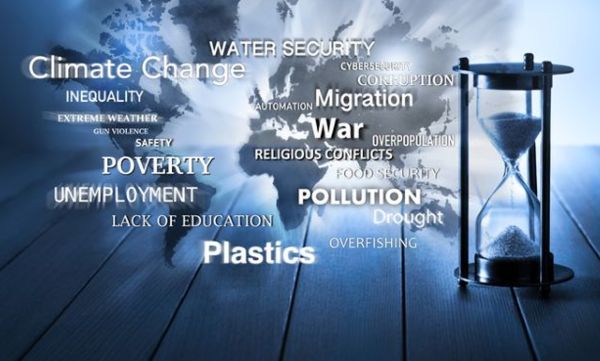
Are the armies, navies and air forces of the nations of the world waging war against climate change? Or are they preparing to wage war despite it?
A recent article in the Bulletin of the Atomic Scientists looks at how the U.S. military is addressing climate change. Its author, Neta C. Crawford, describes Pentagon studies on greenhouse gas emissions going back to the mid-1950s. These studies have hatched projects like the U.S. Navy implementing anti-flood measures on its bases in home waters and around the world.
The Climate “Threat Multiplier” Revealed
In 2014, when I first started researching the subject of climate change and its potential impact on the military, I read the Pentagon’s climate change adaptation roadmap, which included the following statement:
“Climate change will have serious implications for the Department’s ability to maintain both its built and natural infrastructure, and to ensure military readiness in the future.”
Among the issues of concern facing military readiness were the following projections:
- Increased inundation, erosion, and flooding of military infrastructure.
- Changing energy requirements in buildings and installations.
- Disruption of accessible freshwater supplies at military sites.
- Permafrost damage from thawing at Arctic bases.
- Runway, road and other infrastructure damage from extreme heat events.
- Health impacts on personnel from changes in vector-borne disease distribution.
In 2014, the Pentagon called climate change a “threat multiplier.”
Why?
- Because military infrastructure, personnel, and missions would negatively affect readiness.
- Because the nature of missions would also change as rising global geopolitical instability happened, driven by climate disasters.
- Because drought, extreme heat events, food insecurity and freshwater stress would cause rising social unrest and increasing conflicts.
Climate Resilience, Readiness and Risk
The NATO countries that include the U.S., Canada, and Europe have been studying climate change threats to military readiness. The 32 countries have incorporated climate change into their collective strategies and defence planning, reflecting resilience, readiness and risk management.
NATO’s core security priorities include integrating climate risk and resilience, involving:
- Adapting military facilities to more extreme weather conditions.
- Improving operational energy efficiencies.
- Assessing climate impacts on logistics and supply chains.
- Committing to reducing its climate footprint for military activities.
Wars are High Emission Producers
Despite the noble aspirations of military planners to draw down carbon emissions, wars, when started, become big producers of greenhouse gas emissions. That’s because militaries consume more oil and other fossil fuels than anybody and anything else on the planet. Tanks, fighter jets, and ships are big emitters, larger than most civilian sources. Add activities like shelling and bombing leading to fires, and even more CO₂ is emitted.
Use the Russia-Ukraine conflict as an example. Its contributions to climate change over these last four-plus years have produced lots of carbon emissions, including:
- 37% from operations.
- 21% from shelling and bombing.
- From emergency diesel generators and using carbon-intensive fuels for civilian infrastructure after electrical grids and pipelines are destroyed.
- From displacement of populations and post-bombing cleanups and rebuilds.
The net result of the Russia-Ukraine conflict is emission amounts of CO₂ equal to what France produces annually.
Note that when wars contribute to carbon emissions, the numbers don’t get counted in country contributions published by the United Nations and discussed at annual COP meetings.
In other words, the consequences of war on climate change are ignored when determining mitigation and adaptation strategies.
Military Spending and Climate Change
Rising geopolitical conflicts are causing countries to spend more on military hardware.
What part of that increasing spend comes from climate change?
For Russia and Ukraine, not so much. Elsewhere, however, climate change is impacting military spending.
Our destabilizing global climate may partially explain the continuing conflicts and unrest in the African Sahel, Congo and Horn of Africa.
In a recent article posted to the 21st Century Tech Blog, I listed 21 ongoing conflicts. Not included in this batch was the latest Strait of Hormuz tiff. Each of these aforementioned wars, I noted, was adding to the social disruption of the combatant nations and to climate change as well.
So, what is the spending trend? From 2016 to 2025, the Stockholm International Peace Research Institute has documented a 41% increase in global military spending. During that time:
- China has increased spending by 62%.
- Germany has increased spending by 118%.
- U.S. has increased spending by almost 60%.
With all this spending, military emissions continue to rise even when not fighting in a war. So much for mitigation and adaptation.