
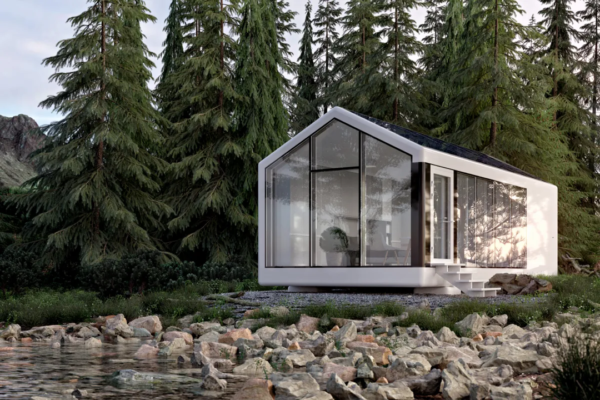
The mOne is a scalable tiny home, built by Haus.me. It delivers flexible designs that start at a bunkie-sized 11.1 square metres (120 square feet) with a deluxe model at 149 square metres (1,600 square feet).
The mOne I read about recently, on the tinyhousetalk.com website, is 37 square metres (400-square feet). It is as large as some studio apartments found in cities like Paris and New York. The finishes and features, however, put those city studios to shame.
All models are factory-manufactured using 3D printing and can be delivered to a site for setup in a single day.
3D Printed with Built-in Compelling Features
The internal features and walls are 3D-printed. The furniture, including a couch that becomes a Murphy bed, along with shelves and cupboards are also 3D-printed. The flexibility of the unit’s internal space produces an open floor plan, giving the mOne a feel of spaciousness.
Comfortable living features include a drop-down cinema-sized projection system for large-scale home entertainment. The fully enclosed hotel-quality bathroom includes a shower, toilet and sink. Meanwhile, a kitchen with oven, microwave, coffee maker, refrigerator, LED-lit cabinetry and shelves, and a stainless steel sink lie hidden behind closet doors so that the kitchen can disappear when not in use. Both the bathroom and kitchen share a common wall.
Haus.me describes the mOne as suitable for sleeping up to 5, although I think that refers to the largest model. The unit featured on tinyhousetalk.com is likely best suited for a solo act, or for two at most.
3D-Printed Structures with Drop-in Solutions
When I recently researched an article that appeared on this site describing the current ability to 3D-print entire communities, I came across the mOne. Unlike the on-site 3D-printed homes I described in that article, this tiny house is factory-manufactured.
Its material is 3D-printed composite polymer, featuring transparent sections that offer floor-to-ceiling panoramic views. It is manufactured in one piece with no wall framing required.
That means everything is prebuilt, including light fixtures, plumbing, and venting. Kitchen appliances and bathroom fixtures are added.
Power to the home comes from rooftop solar panels with battery backup. Water for internal use is collected by a built-in atmospheric condenser. A HEPA filter keeps the internal air fresh. Wastewater gets fully recycled, meaning no need for a septic tank. All environmental and energy issues are managed by built-in Smart Home software.
mOne claims it’s autonomous from Day One, requiring no pre-built external infrastructure. As a result, it can be up and running within a day of delivery.
mOne pricing starts at US$ 89,990 for the smallest model. The price of the configuration featured on the tinyhomes website was $499,990. The largest model costs over a million. A YouTube video provides a guided tour of a 37-square-metre model.
Taking 3D-Printed Solutions Beyond Homes
If you can drop a standalone 3D-printed home on a lot ready to go in a day, think of other solutions these types of factory builds can deliver.
When 3D printing started, it was seen as a technology for hobbyists and prototyping. Today it is being used to print objects as small as medical devices and as large as wind-turbine blades.
Now, imagine using the Haus.me technology to build other types of structural shells that can become classrooms, shops, pavilions, field hospitals, medical clinics, military barracks, disaster-relief shelters, bridges, depots and storage tanks, flood control structures, and more.
Designs can be endless, software-created, factory-built, and fully equipped. Haus.me is opening a door to an as-yet untapped goldmine where 3D-printing can take us.