
Before agreeing to surgery to have my osteoarthritic left knee replaced with a prosthetic one, I frantically searched for regenerative medical solutions that could regrow the joint using my own stem cells. I was stymied by the snail’s pace of progress in replacing failed knee joints with living replacements.
During the COVID-19 pandemic, with the knee getting progressively worse, I decided to have the joint surgically repaired. I can’t complain about the decision that I made back then in 2020 because I made a rapid recovery, and my prosthetic joint works like a charm. It is even more flexible than my right knee, which is a little arthritic but far removed from needing to be replaced.
Having said that, I recognize that my artificial knee joint may eventually fail. The average lifespan is between 15 and 20 years. You can switch a failed joint with a replacement, but it comes with a higher risk of infection, long recovery times and, in the end, lower mobility.
Neogenesis was the subject of a posting on this site last week. Neogenesis is the science of regrowing body parts, and it is still in its early days. But the news from a medical team from Columbia University is encouraging. Clark Hung and Nadeen Chahine, biomedical engineers at Columbia’s School of Engineering, have been the project leads working on a funded Advanced Research Projects Agency (ARPA) contract to create biological knee joints.
Arthritic Knees is a Growth Industry
The advantage of growing a knee versus replacing one cannot be underestimated. The numbers tell the tale.
Osteoarthritis affecting the knee joint impacts 375 million around the globe. That number keeps on climbing as our global population ages, and incidents of obesity continue to grow.
Here are some statistics that may surprise you:
- Nearly 100,000 Canadians undergo knee replacement surgery annually, an average of one per every 400 adults.
- In the United States, knee replacement surgeries are closer to one million.
- Globally, the number is somewhere between 2 and 2.5 million.
- By 2030, it is estimated that nearly 3.5 million knee replacement procedures will be performed annually.
Of those who receive artificial knee joints, approximately 20% have implant issues, from loose hardware to joint instability, infections and diminished mobility and quality of life.
Introducing NOVAKnee
Creating a biological knee joint can produce a permanent repair that lasts a lifetime. With a biological knee, younger people who suffer from osteoarthritis of the knee and wait for long periods as older patients get surgical priority can get a living knee.
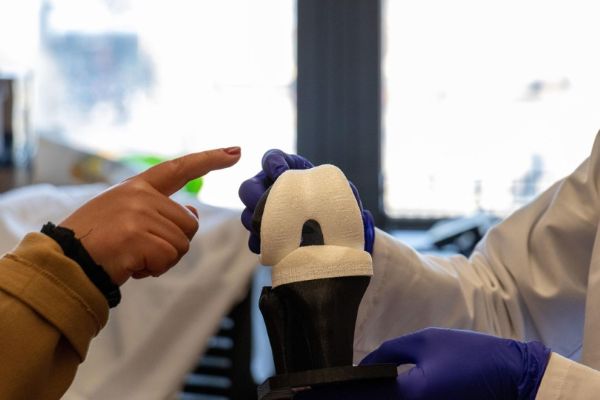
NOVAKnee is a product of more than two decades of research from Columbia’s School of Engineering, Dental Medicine, Orthopedic Surgery and the Columbia Stem Cell Initiative. The implant looks a bit like current prosthetic knee joints but is a living, 3D-printed body part.
NOVAKnee is built from stem cells (the God cell) harvested from a patient’s abdomen, called lipoaspirate, or from adult pluripotent stem cells, generated from a patient’s skin cells and then cultured.
The biodegradable scaffolding built from living biomaterial produces collagen, cartilage, chondrocytes, ligaments, tendons and the ends of the leg’s two long bones, the femur and tibia, as well as the patella.
Described by Time Magazine as one of the best inventions of 2026, it is expected to become available for widespread use within a few years. So, nine years plus two or three more after I started researching and pursuing a solution using stem cells to grow a knee joint, 21st-century technological innovation will have succeeded. Where was NOVAKnee when I needed it?